snps explained
Homozygous vs Heterozygous Genotypes in Raw DNA
Compare homozygous and heterozygous genotype calls in raw DNA data, with examples, limits, and the context needed before interpreting a marker.
GenoSight Team · October 3, 2026 · 5 min read
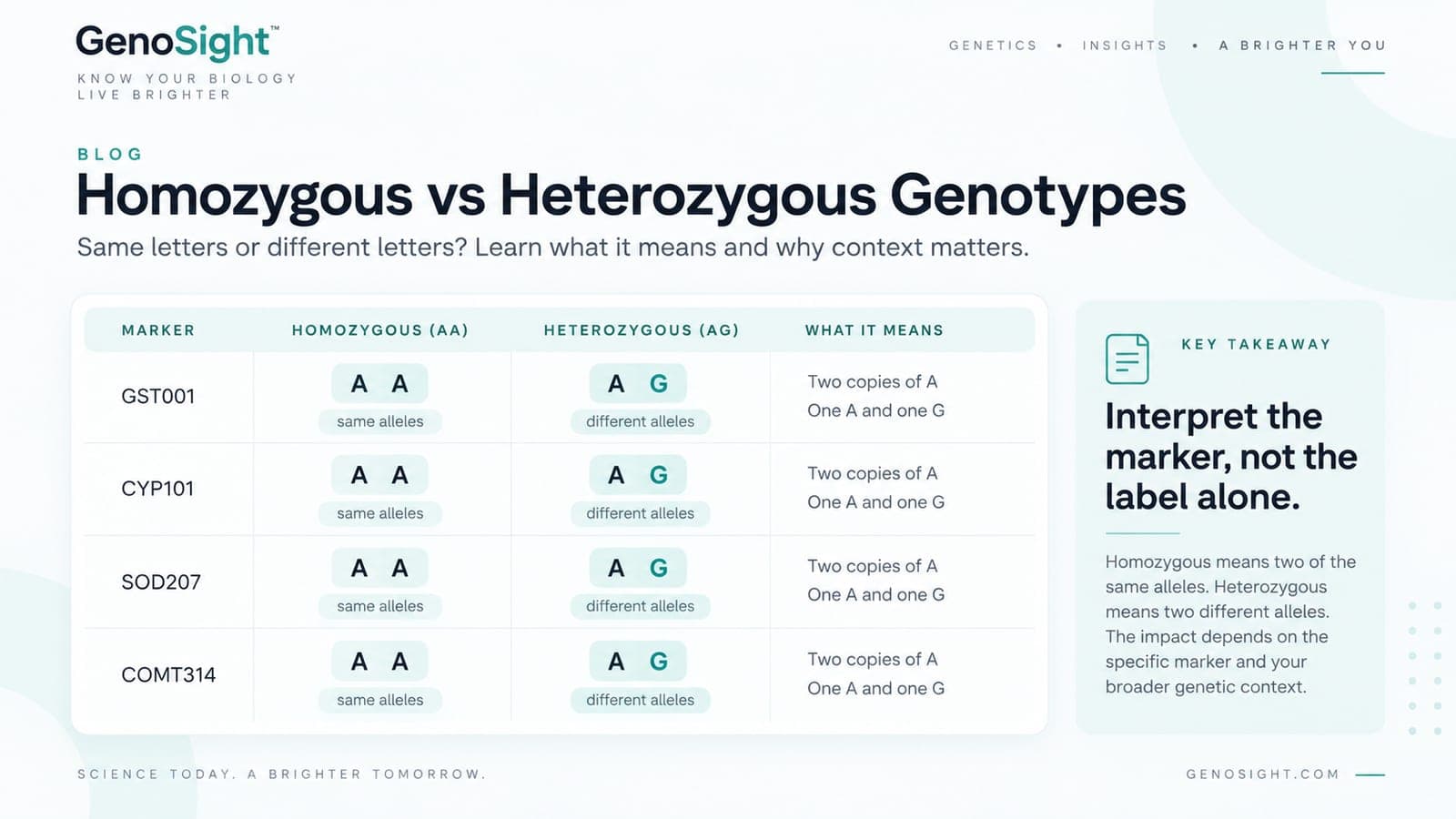
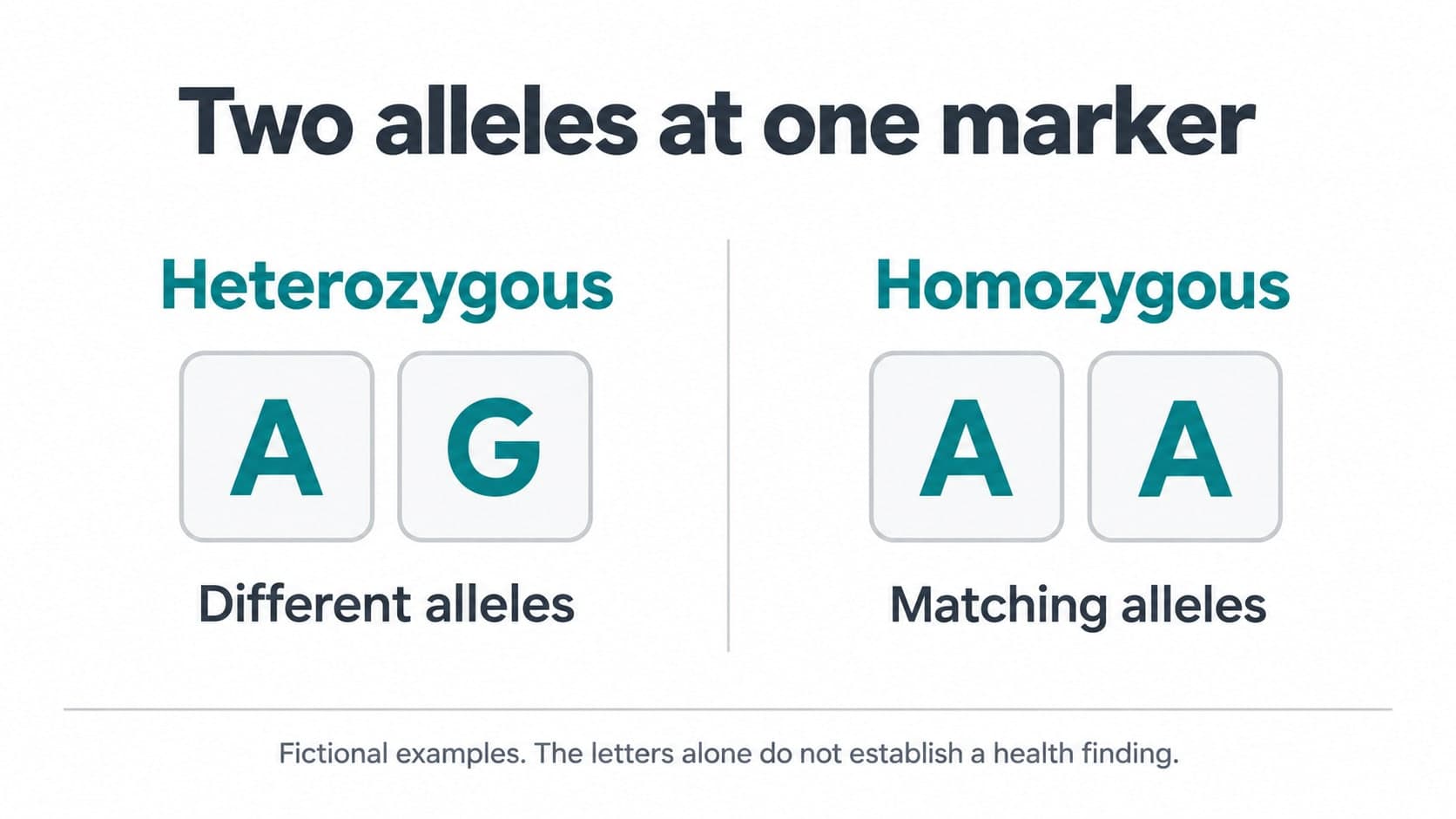
Homozygous and heterozygous genotypes describe whether the two reported alleles at one specific marker match. A homozygous call has matching alleles, such as AA, and a heterozygous call has different alleles, such as AG. Neither label, by itself, says whether a result is harmful, protective, clinically important, or irrelevant.
That direct distinction is useful, but it is only the first reading step. In raw DNA data, the safer question is not "Am I homozygous or heterozygous?" It is "Which marker is this, what alleles were reported, and what evidence supports any interpretation attached to them?"
Evidence checked October 3, 2026. All marker names and genotype examples below are fictional teaching examples, not real rsIDs, medical findings, or personal results.
The side-by-side difference
The NHGRI genotype glossary describes a genotype as the variant present at a particular location in the genome. The NHGRI allele glossary explains that a person may inherit two alleles at a genomic location, one from each parent, where such variation exists. When those alleles are the same, the call is homozygous; when they differ, it is heterozygous.
The key phrase is "at a genomic location." You are not generally homozygous or heterozygous as a whole person. You can be homozygous at one marker, heterozygous at another marker, and missing a call at a third marker in the same file.
| Question | Homozygous genotype | Heterozygous genotype |
|---|---|---|
| Allele relationship | The two reported alleles match | The two reported alleles differ |
| Fictional example | AA or CC | AG or CT |
| What the label describes | A relationship between alleles at one locus | A relationship between alleles at one locus |
| What the label does not prove | Disease, safety, carrier status, or severity | Disease, safety, carrier status, or severity |
| First raw-file check | Marker, build, provider, strand, and call quality | Marker, build, provider, strand, and call quality |
The NCI genetics dictionary definition of homozygous genotype uses the same core rule: two identical alleles at a particular gene locus. The NCI definition of heterozygous genotype describes two different alleles at a particular gene locus, including cases where the two variants differ from each other.
How to read a raw DNA row
Raw DNA files from consumer providers usually show rows with a marker identifier, chromosome, position, and genotype. The exact columns vary by provider, but the reading discipline is similar: keep the marker context attached to the two letters.
| Fictional marker | Chromosome | Position | Reported genotype | Basic label | What remains unknown |
|---|---|---|---|---|---|
| GST001 | 1 | 100001 | AA | Homozygous | Whether this marker has any health meaning |
| GST002 | 1 | 100027 | AG | Heterozygous | Whether either allele matters |
| GST003 | 7 | 700010 | CC | Homozygous | Whether the call is common, rare, benign, or relevant |
| GST004 | 7 | 700055 | CT | Heterozygous | Whether an interpretation source applies to this marker |
The label is a description, not a verdict. AA is homozygous in the table because the two reported letters match. AG is heterozygous because the two reported letters differ. That alone does not say whether A is better than G, whether G is a risk allele, or whether the marker should be used for a health decision.
Before interpreting a row, preserve the original marker identifier. If the marker is an rsID, our rsID meaning guide explains why the rs number identifies the marker rather than the health effect. If the same marker appears to have different letters in another source, check DNA strand orientation before calling it a conflict. If the position does not line up, check GRCh37 vs GRCh38 before assuming the files refer to different biology.
Why the label is not the interpretation
Many top-ranking explanations stop at classroom examples such as AA, Aa, and aa. That is helpful for learning the terms, but raw DNA interpretation needs stricter boundaries. A real marker can be common or rare, studied or poorly studied, directly genotyped or imputed by another tool, relevant to one condition or irrelevant to health.
Inheritance pattern also matters. MedlinePlus Genetics explains inheritance patterns such as autosomal dominant, autosomal recessive, X-linked, mitochondrial, and complex inheritance. In one context, a single relevant variant can matter. In another, variants in both gene copies may be needed. Many common health traits involve multiple genes and non-genetic factors instead.
That is why neither label should be translated into a diagnosis. A homozygous result is not automatically worse than a heterozygous result. A heterozygous result is not automatically a carrier finding. Carrier interpretation requires a specific variant, a gene-disease relationship, an inheritance pattern, and often clinical confirmation.
If a database or report classifies a specific variant as uncertain, benign, likely pathogenic, or pathogenic, read that classification separately from the zygosity label. Our VUS guide explains why an uncertain classification should remain uncertain until better evidence is available.
Cases that need extra care
The AA versus AG classroom example assumes a clean two-allele call at an autosomal diploid marker. Raw files can be messier.
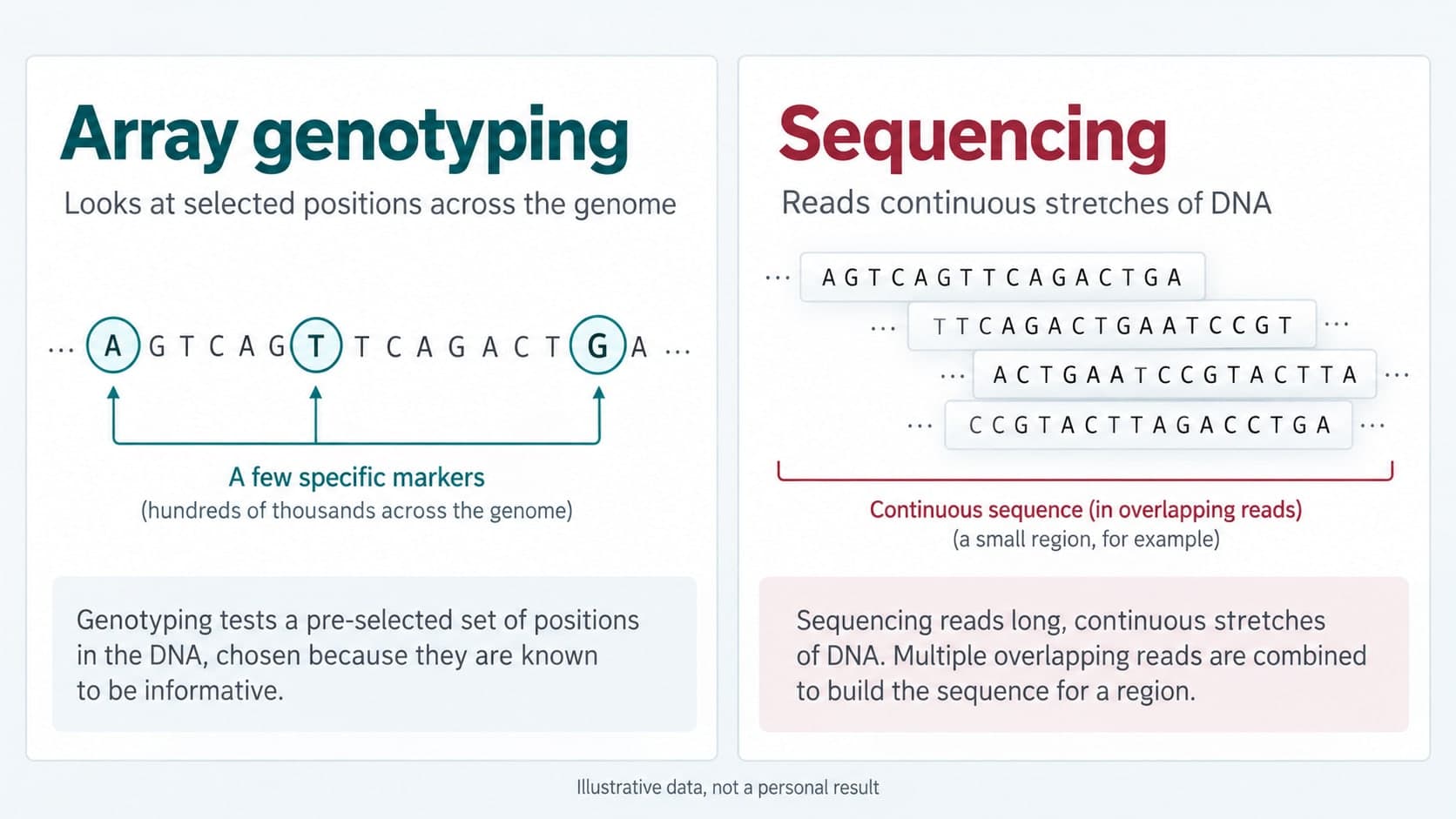
Missing calls should not be forced into a homozygous or heterozygous category. If a provider uses a no-call symbol, blank value, or nonstandard code, keep the original value and check the provider documentation. Our genotyping vs sequencing guide also explains why a consumer array file may not measure every location someone asks about.
Sex chromosomes need careful context. Some markers may not behave like a two-copy autosomal example for every person. Insertions, deletions, copy-number changes, mitochondrial DNA, and structural variants can also require representations that do not fit a simple two-letter table.
Compound heterozygous is another term to keep separate. It usually means two different relevant variants in the same gene, one on each copy, rather than a single simple AG marker. Do not infer compound heterozygosity from two unrelated rows in a raw file unless a qualified source has established phase, gene context, and disease relevance.
A practical GenoSight workflow
When GenoSight frames a raw DNA result for education, the workflow is intentionally slower than a label lookup. First, identify the marker, provider, position, reported genotype, and reference build. Then separate three questions:
- What exactly was measured or reported?
- What does the genotype label describe at that marker?
- What evidence supports any health or trait interpretation?
Those questions protect against two common mistakes. The first mistake is treating a technical label as a medical conclusion. The second is treating an online explanation of a similar-looking allele pair as if it applies to the exact marker in your file.
For an educational preview, see a GenoSight sample report. For file setup, start with how to download raw DNA data. For clinically important findings, discuss the original result with an appropriate healthcare professional rather than changing treatment, screening, or supplements from a raw-file label alone.
See a sample report
Preview how GenoSight separates raw genotype context from educational interpretation before you upload a file.