snps explained
Genotyping vs Sequencing: What Your DNA File Contains
Compare array genotyping and DNA sequencing by coverage, output and limitations, then check what an existing raw DNA file can actually support.
GenoSight Team · September 22, 2026 · 4 min read
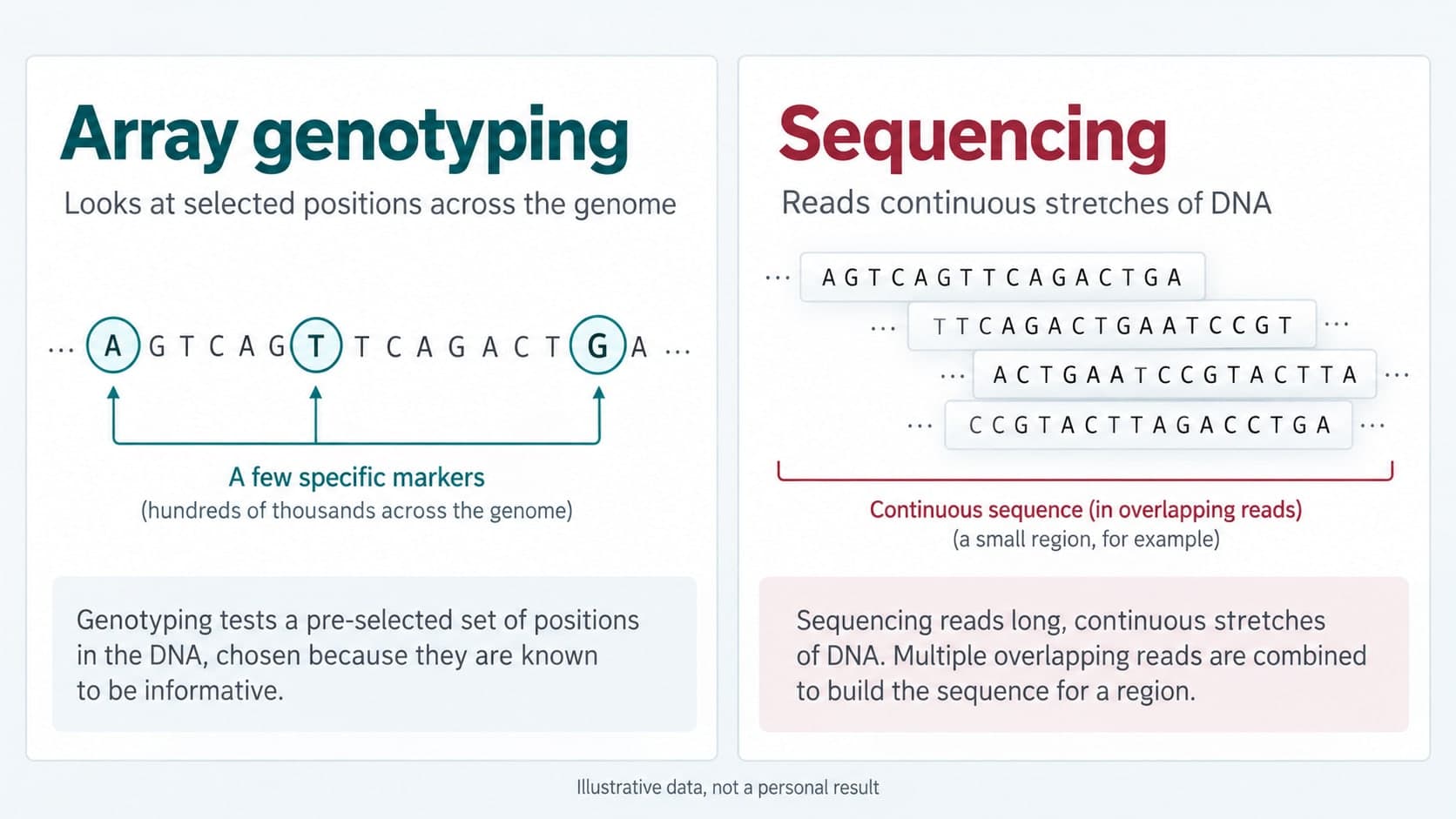
Array genotyping checks a selected set of DNA positions, while sequencing determines the order of DNA bases within the regions a test reads. Sequencing can cover a targeted region, an exome or a genome; the word alone does not tell you the scope. Reanalyzing an existing array file does not turn it into newly measured sequencing data.
If you already have a raw DNA download, start with what was measured, not with the number of pages in a later report. A report can reorganize results, add references and explain findings without expanding the original laboratory measurements. That distinction helps you ask useful questions before uploading a file or choosing another test.
Evidence checked September 22, 2026. This is a comparison of methods, not a ranking of commercial tests.
What does each method measure?
The Federal Judicial Center's explanation of DNA genotyping describes SNP arrays as probes directed at selected positions. The set of positions is part of the array's design. An array result therefore needs to be read in the context of that design, rather than as a continuous account of every region between the reported markers.
Array genotyping: Best for checking a predefined set of markers when that set fits the question. Its main limitation in this comparison is scope: a marker outside the selected set has not become a directly measured result merely because an interpretation website discusses it.
The National Human Genome Research Institute's sequencing fact sheet explains sequencing as determining the order of DNA bases. The amount and type of sequence examined still depend on the test. A short targeted sequencing test and a genome sequencing test are not interchangeable purchases or datasets.
Sequencing: Best for examining sequence variation within the regions the chosen test covers. Its limitation is that broader sequence information still needs analysis and interpretation; a sequence difference is not automatically a useful health finding.
There is also a terminology trap. Genotyping is the act of determining genetic variants, and sequencing can be used to do that. Illumina's sequence-based genotyping overview describes such methods. Here, the everyday comparison is specifically array genotyping versus sequencing, not a claim that the two terms describe mutually exclusive scientific activities.
Compare the same questions on both sides
| Question | Array genotyping | Sequencing |
|---|---|---|
| What is examined? | Positions selected for the array | Sequence within the regions included in the test |
| What should you check? | Marker coverage and reporting conventions | Target regions, usable coverage and reporting conventions |
| What does a missing result establish? | It does not by itself establish the genotype at an unreported position | It does not by itself establish that a region was adequately assessed |
| What can later interpretation change? | Explanations and annotations of the available data | Explanations and annotations of the available data |
| What remains necessary? | Appropriate validation and interpretation | Appropriate validation and interpretation |
For example, suppose a fictional array lists markers A, B and C, while a question concerns marker D. A longer report about A, B and C does not supply a new laboratory observation at D. Equally, a document labeled sequencing needs enough detail to show whether the relevant region was within its scope. The label is a starting point for checking coverage, not the answer to every coverage question.
Sequencing has several different scopes
MedlinePlus distinguishes whole-exome from whole-genome sequencing. Exome sequencing focuses on protein-coding regions. Genome sequencing has a broader scope, including regions outside those exons. Targeted sequencing can examine a smaller selected region or group of genes.
This is why it is worth asking for the exact test description. A summary that says only "DNA sequencing" leaves out the information needed to compare it with another service. Keep the laboratory's explanation of what was included, what could not be assessed and what the report is intended to establish.
More information can also mean more uncertainty. MedlinePlus notes that the significance of many identified changes is unknown. A larger dataset should not be treated as a promise that every finding has a settled explanation. Coverage and interpretation are separate dimensions, and both matter when considering whether a result answers your question.
Check an existing file before reusing it
Keep the original download and its header. Record the provider, test or platform description, download date, stated reference build and the receiving tool's supported formats. Our raw DNA download guide is a useful starting point for retrieving the original export rather than reconstructing it from a spreadsheet.
Ask the receiving service three concrete questions:
- Does it accept this exact provider export or sequencing output?
- Which findings depend on directly reported measurements, and are any inferred instead?
- How does it handle missing data, unsupported markers or uncertain interpretations?
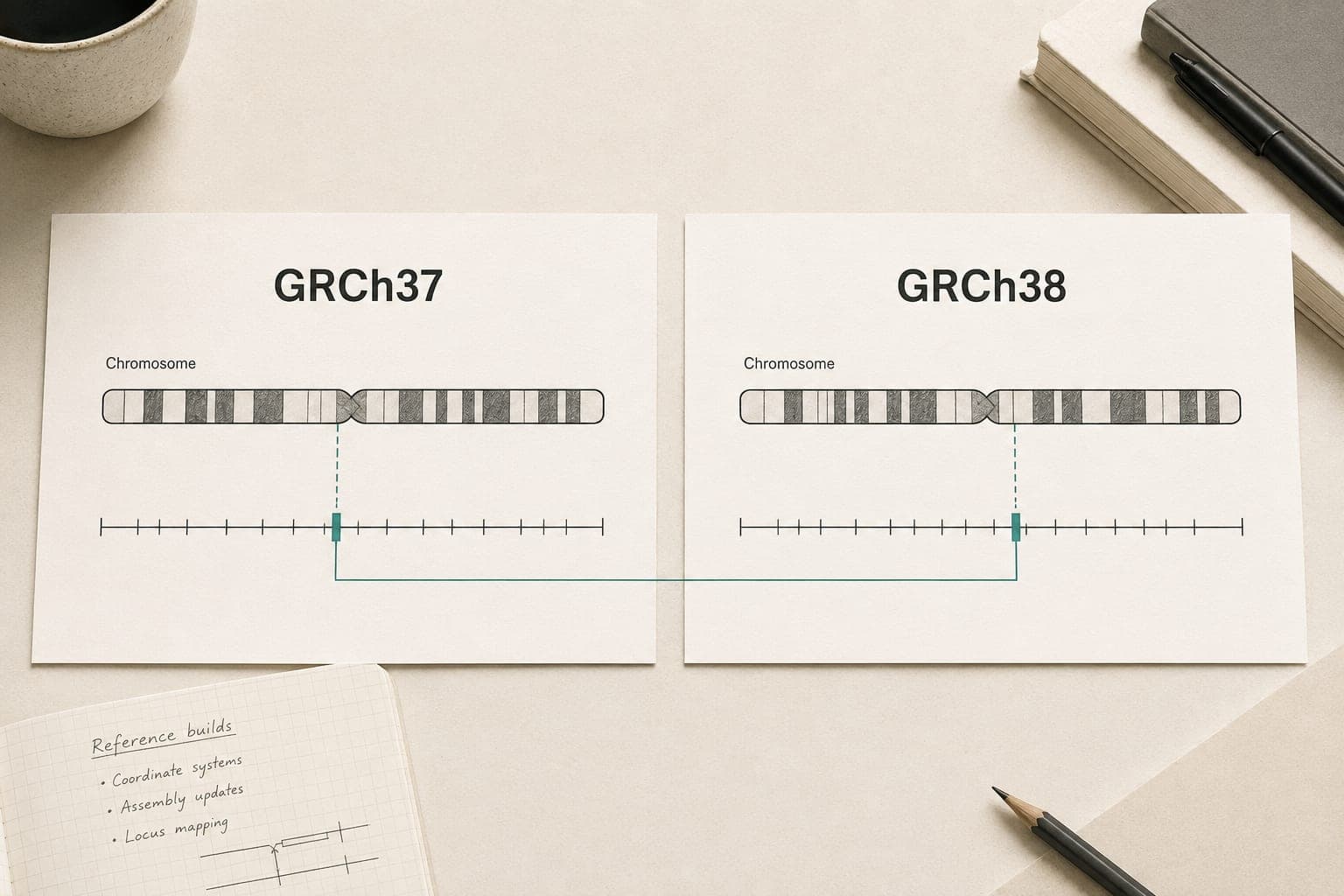
Do not rename a file or remove information just to make an upload succeed. A successful upload only shows that software accepted something; it does not establish that the data had the scope needed for your question. If two sources use different coordinate systems, our GRCh37 and GRCh38 guide explains another comparison check.
Choose the next step for the question you have
For learning about an existing download, a readable explanation with traceable sources can be useful. Review an example before sharing genetic data, and check the service's current handling and deletion terms. You can see a GenoSight sample report without treating an educational interpretation as a new laboratory test.
For a clinically important concern, take the original result and the question to an appropriate healthcare professional. The choice is not simply "more data is better." It is whether a particular test and its interpretation can address the concern. Neither an array label nor a sequencing label, on its own, establishes a diagnosis or supports changing treatment.
See a sample report
Review an educational explanation before deciding whether to upload your original file.