snps explained
DNA Strand Orientation: Why Genotype Letters Can Differ
Understand plus and minus strands, complementary allele letters, and the reference checks needed before deciding that two raw DNA results disagree.
GenoSight Team · September 18, 2026 · 4 min read
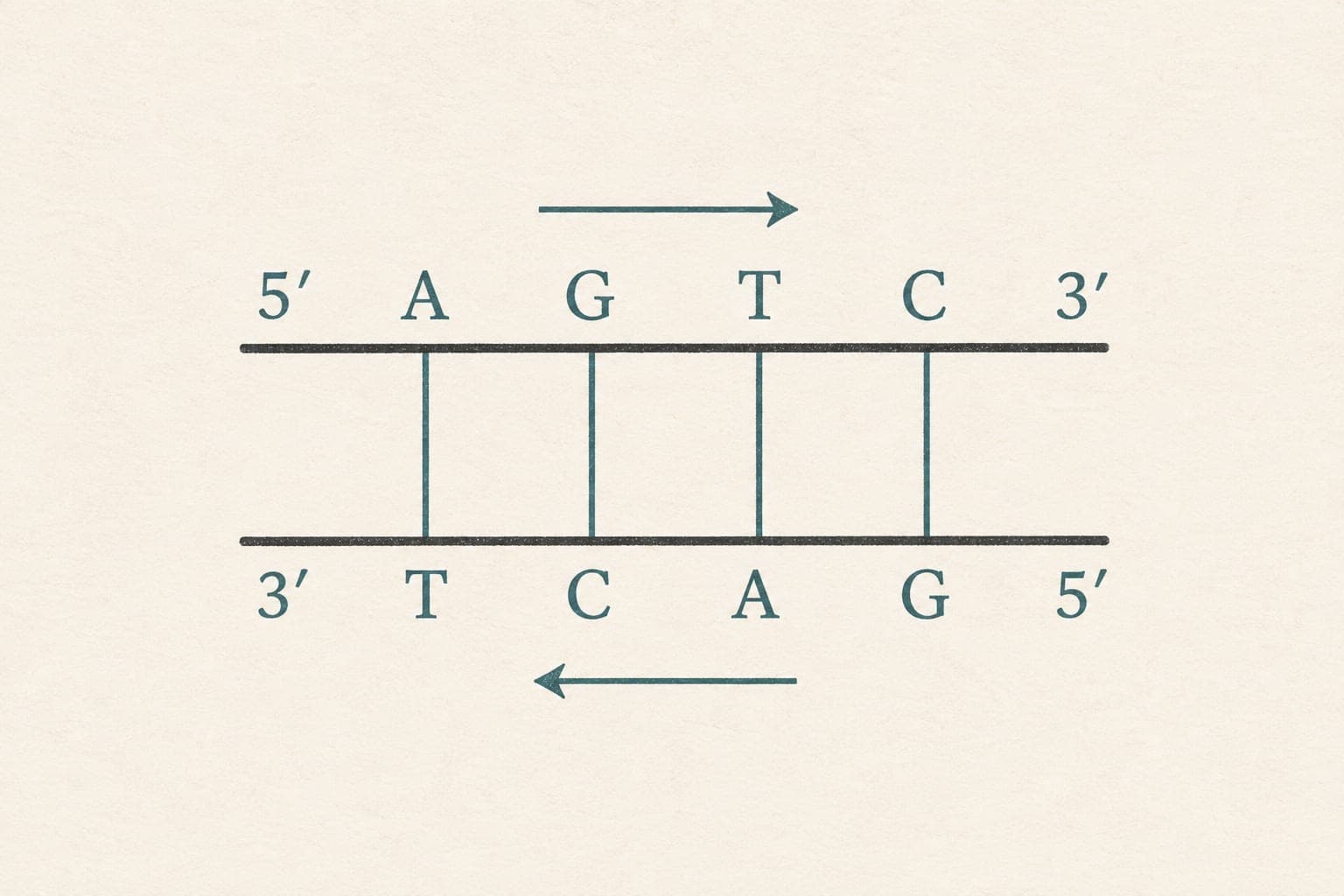
DNA strand orientation describes the direction and reference strand used to write a DNA sequence or report alleles. Complementary bases pair A with T and C with G, so equivalent information can use different letters when written from opposite strands. Check the reporting convention before deciding that two genotype results conflict.
For someone reading raw DNA data, this is a notation problem to resolve before interpreting a result. It is separate from the reference genome build, the accuracy of the measurement and any health claim attached to a marker. A convenient letter match is not enough to establish all four.
What do 5-prime and 3-prime mean?
DNA strands have direction, conventionally described using their 5-prime and 3-prime ends. The two strands in a paired DNA segment run in opposite directions. The IMGT strand guide explains sequence orientation and terminology used for coding and template strands.
When writing a sequence, the usual convention is 5-prime to 3-prime. If you switch to the opposite strand while keeping that writing convention, both the base letters and their order need attention. A short invented sequence makes the distinction visible:
| Representation | Sequence |
|---|---|
| Original, left to right | 5-prime AGTC 3-prime |
| Paired complement, left to right | 3-prime TCAG 5-prime |
| Opposite strand written 5-prime to 3-prime | 5-prime GACT 3-prime |
These four-base examples illustrate notation only. They are not a real person's genetic result and carry no health interpretation. The Wageningen sequence-notation resource explains why writing the opposite strand in the conventional direction requires a reverse complement.
Genotype letters are not a short DNA sequence
A two-letter genotype for an ordinary diploid single-base marker usually describes the two alleles reported at one location. It is not a two-base stretch to reverse in the same way as the sequence above. This distinction prevents a common mistake when people try to apply a sequence-conversion rule to every field in a raw file.
Consider a fictional AG genotype reported relative to one strand. Complementing each allele gives TC on the other strand. In an unphased genotype, TC and CT describe the same unordered pair. That example explains how different letters can be compatible, provided that the records really refer to the same marker and opposite reporting strands.
It does not mean that any AG and CT results should be declared equal. A different marker, wrong reference assembly or incorrectly copied row can produce a misleading comparison. Establish the underlying record first, then apply the documented convention. Do not choose whichever transformation makes an inconvenient disagreement disappear.
Which strand does a consumer file use?
Read the testing company's documentation for the particular export. Terms such as plus, minus, forward, reverse, coding and template are used in related but different contexts. A gene's coding direction is not a universal instruction to flip every genotype on a chromosome.
23andMe documents its plus-strand reporting convention relative to the specified reference genome. Its documentation also discusses the reference build. That combination illustrates why a strand statement should stay attached to its reference context rather than being remembered as an isolated rule.
Keep the original provider file, including the explanatory header. If you need another copy, use our raw DNA download guide. Avoid saving a spreadsheet over the only original: formatting changes can make a support question harder to reproduce, even if the underlying issue was just a reporting convention.
Why A/T and C/G markers need extra care
Complementing the pair A/T produces T/A; complementing C/G produces G/C. The unordered pair contains the same two letters after the transformation. The letters alone therefore cannot tell you which orientation was used for that marker. This is a direct consequence of the complementary base pairs, not evidence that the marker is clinically unusual.
Do not use an ambiguous pair as a shortcut to infer the strand of an entire file. Use the provider's declared convention and the relevant reference information. If the documentation is missing, record that uncertainty rather than filling it in from a single row.
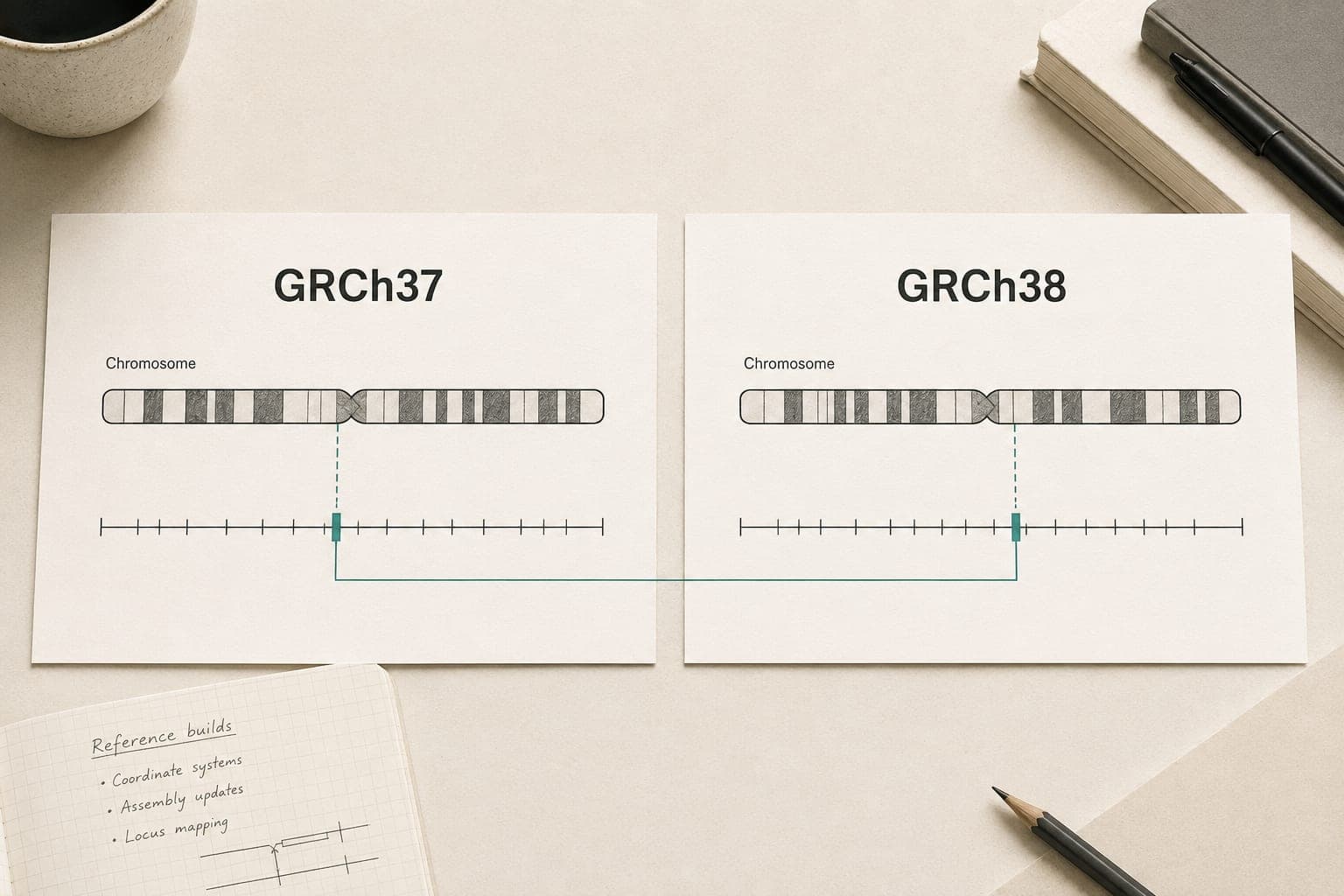
Also keep build and strand separate in your notes. A coordinate mismatch between GRCh37 and GRCh38 is not repaired by complementing A to T. Likewise, selecting the same build on two websites does not prove that every displayed allele uses the same strand. Each comparison has to establish both pieces of context.
A safe way to investigate a mismatch
Write down the exact marker identifier, chromosome, position, genotype, build and strand convention from each source. NCBI's RefSNP documentation describes how variant records connect identifiers, alleles and reference placements. Use the actual record details rather than a search-result headline.
Then classify the question you are asking. Are the coordinates different? Are the allele letters complementary? Does one source omit its reference? Is one entry a database's possible alleles while the other is your reported genotype? These questions lead to different checks and should not be collapsed into a general claim that one company is wrong.
For an unresolved technical issue, ask the provider or receiving service with the smallest relevant, redacted example. Keep unrelated markers and personal identifiers private. Preserve the original data while waiting for an explanation; do not repeatedly flip alleles and upload modified copies to see which result looks better.
Resolving notation can make two records comparable, but it does not validate a medical interpretation. Clinically important findings need appropriate review using the original evidence. To preview an educational explanation before uploading data, see the GenoSight sample report and check that the service supports your original file format.
Preview GenoSight's educational explanations
Open the sample report to see how genetic information and its limits are presented.