snps explained
rsID Meaning: How to Read the Labels in Raw DNA Data
Learn what an rsID identifies, how it differs from your genotype, and which reference details to check before interpreting a marker in raw DNA data.
GenoSight Team · September 15, 2026 · 4 min read
An rsID is a reference SNP identifier used to label a variant locus in the dbSNP database. An rsID identifies the record; your genotype describes the alleles reported for you at that marker. Seeing an rsID in a raw DNA file does not, by itself, mean that you carry a harmful variant.
The difference matters when you paste a marker into a search engine. The results may mention a trait or condition, but a page about that marker is not a personal result. Before interpreting the search, read the rest of the row and find out what the reference actually says.
What does the rs number identify?
NCBI's RefSNP documentation describes the reference records behind rsIDs. Submitted observations are grouped into RefSNP records. The identifier provides a shared label that can be used across studies and reference assemblies; the number is not a chromosome coordinate or a measure of severity.
Despite the historical SNP name, dbSNP also includes several other kinds of small variation. It is therefore unwise to assume that every rsID describes exactly one single-letter substitution. Open the record and check the variant representation when that distinction matters.
The NHGRI explanation of SNPs describes variation at a single DNA base and how such markers can help researchers investigate traits and disease. A marker used in an association study does not automatically identify the biological cause of a condition. The label tells you where to start reading, not which conclusion to reach.
Read a raw-data row as a set of fields
A typical consumer export includes a marker identifier, chromosome, position and one or more columns for the called alleles. The exact format varies. Read the provider's header before assigning meanings to unfamiliar symbols or column names.
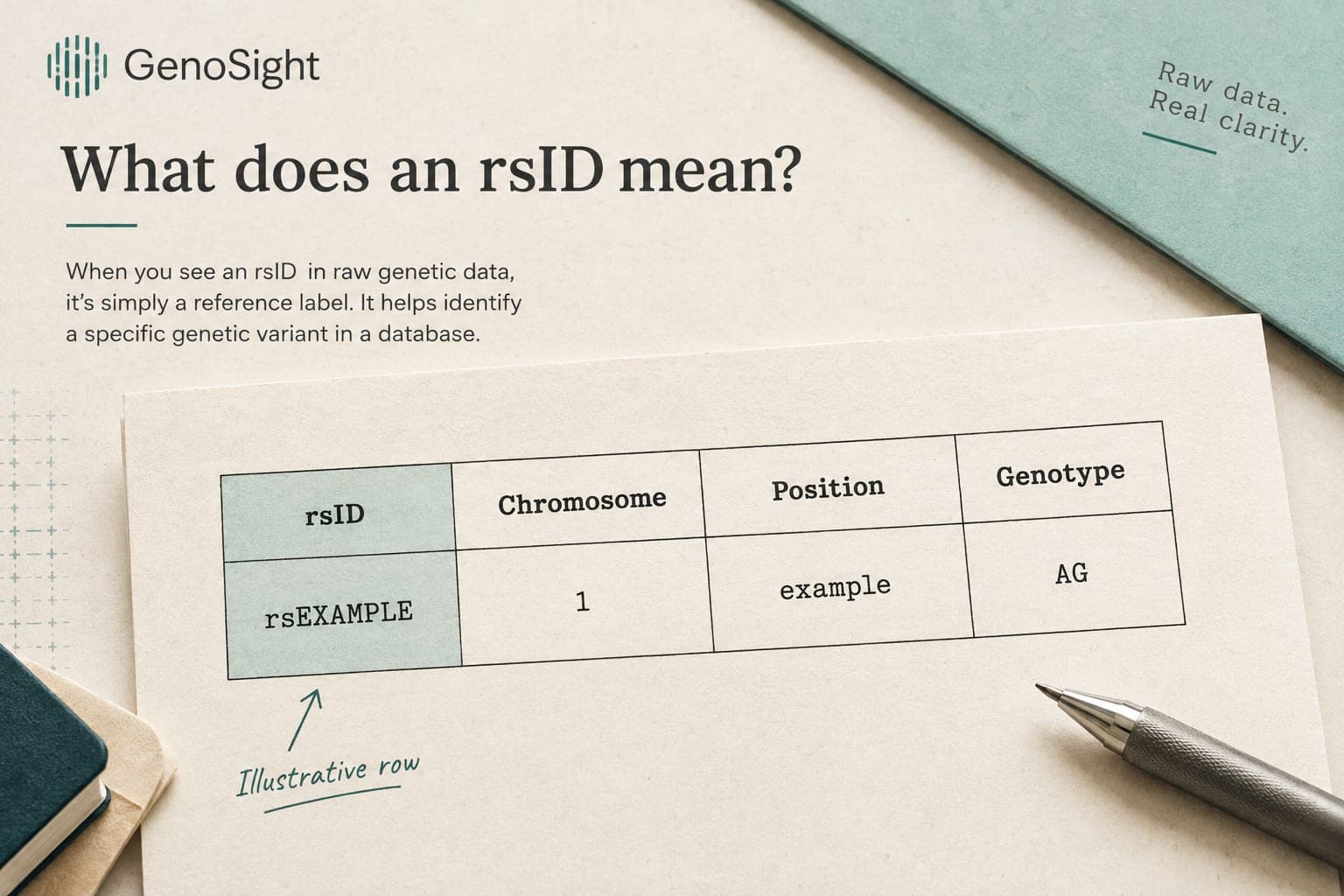
Here is a deliberately fictional example, with no real variant or health claim attached:
| Field | Illustration | What it contributes |
|---|---|---|
| Marker | rsEXAMPLE | A placeholder for the record identifier |
| Chromosome | 1 | The chromosome label in the file |
| Position | Example position | A location that needs its reference build |
| Genotype | AG | The two allele letters reported in this illustration |
The identifier and the genotype play different roles. Two people can have a row for the same marker while their called alleles differ. A database can also list multiple possible alleles at a locus. Those possibilities are not a list of everything present in your own sample.
For an ordinary unphased, diploid single-base call, the order of two allele letters does not establish which parent contributed each allele. Do not read the first column position as maternal and the second as paternal unless the format explicitly provides that information. If the file uses unfamiliar coding, ask the provider rather than extending this simple example to every chromosome or variant type.
A careful lookup takes more than the identifier
Start with the exact marker from an untouched export. Our raw DNA download guide explains how to obtain the provider's original file. Keep its header, date and format information with any notes you make.
When opening a database result, work through these questions:
- Does the returned record match the identifier, including any merge notice?
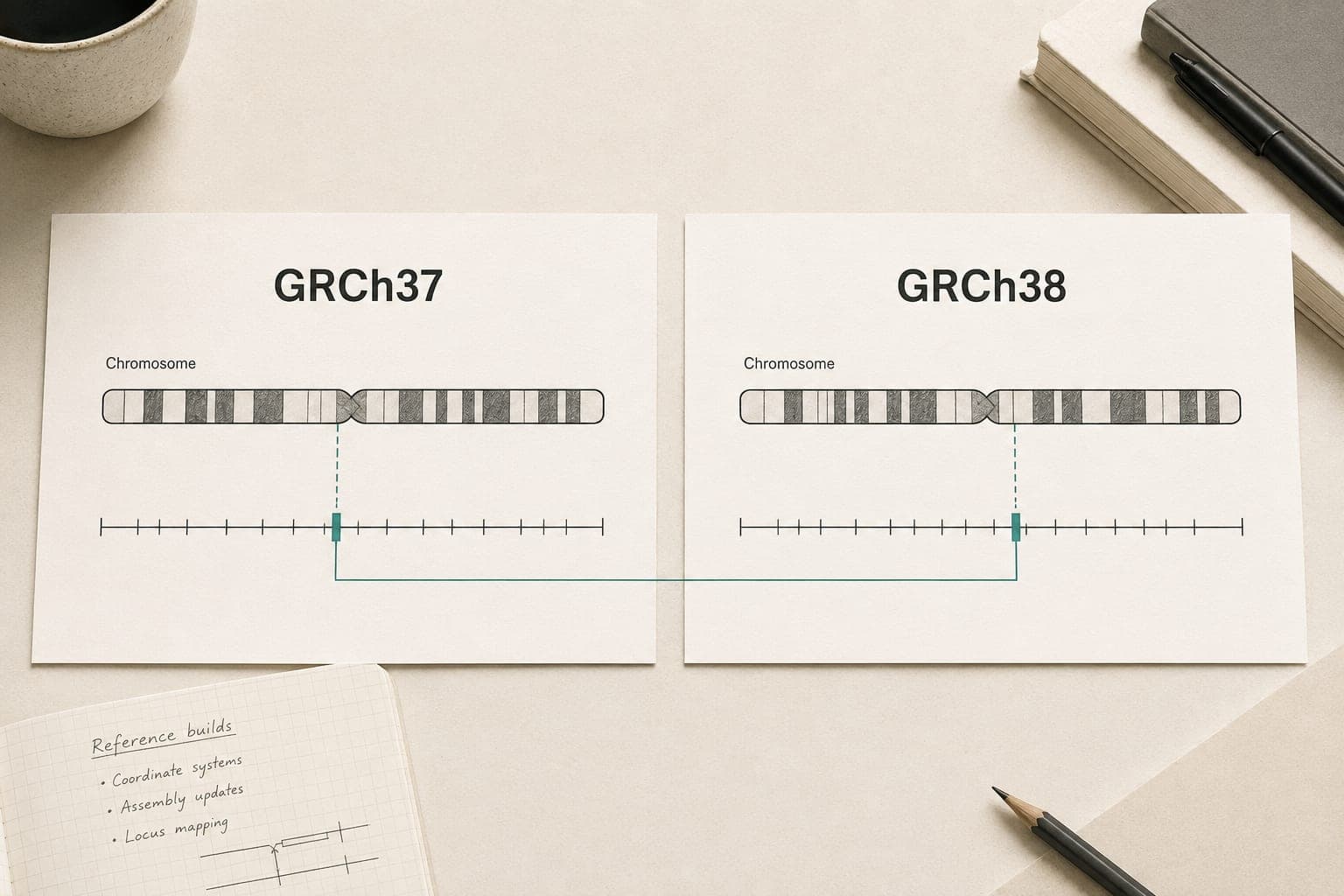
- Does its reference assembly match the build used in your file?
- Are you comparing the same alleles and strand convention?
- Is a claim about this exact variant, or only about a nearby marker or gene?
- Does the source explain the evidence and the limits of the interpretation?
This is a reading checklist, not a method for diagnosing yourself. If you cannot establish one of the technical matches, stop there. A screenshot with the missing context hidden is less useful than a short note describing what you could and could not verify.
Why an identifier may look unfamiliar
23andMe explains its rsID and internal marker labels. Some markers in its data use identifiers beginning with an i rather than an rs label. An internal identifier may not have the same meaning outside the provider's system. Do not create an rs number by replacing the first letter.
Database records can also change through merging or withdrawal. If an old reference directs you to a newer record, keep track of that relationship rather than treating the old and new identifiers as two independently measured findings. Follow the database's own record history, not a conversion supplied by an unknown website.
A missing search result is similarly inconclusive. It may reflect a provider-specific label, a spelling problem or a record-history issue. It does not establish that you have a newly discovered disease variant. Record the question and use the provider's documentation or support channel to clarify the label.
From a label to a health claim
There is a large gap between locating a variant record and deciding what it means for a person's health. The precise allele, measurement quality, inheritance, clinical context and evidence all matter. A headline attached to a search result cannot replace those details.
If your search reaches ClinVar, read the condition and review information. ClinVar explains its review-status system: stars concern the review process behind submitted assertions, rather than the seriousness of a condition. A record appearing in a clinical database is not proof that a raw-data match has been clinically confirmed in you.
Avoid making medication or screening decisions from an isolated lookup. Bring clinically important concerns to an appropriate professional with the original report and enough context to identify the result. You do not need to broadcast your full genetic file in a public comment to ask what rsID means.
For a preview of educational report language, read the GenoSight sample report. It lets you evaluate the format before deciding whether to use the service. The purpose of an explanation is to make evidence and limitations easier to understand, not to turn a database identifier into a diagnosis.
Explore an example genetic report
See the educational format and limitations in GenoSight's sample report.