clinical genetics
Variant of Uncertain Significance: Reading a VUS Result
Understand what a VUS means, why a database match is not a diagnosis, and which questions to take to the clinician or laboratory reviewing your result.
GenoSight Team · September 8, 2026 · 4 min read
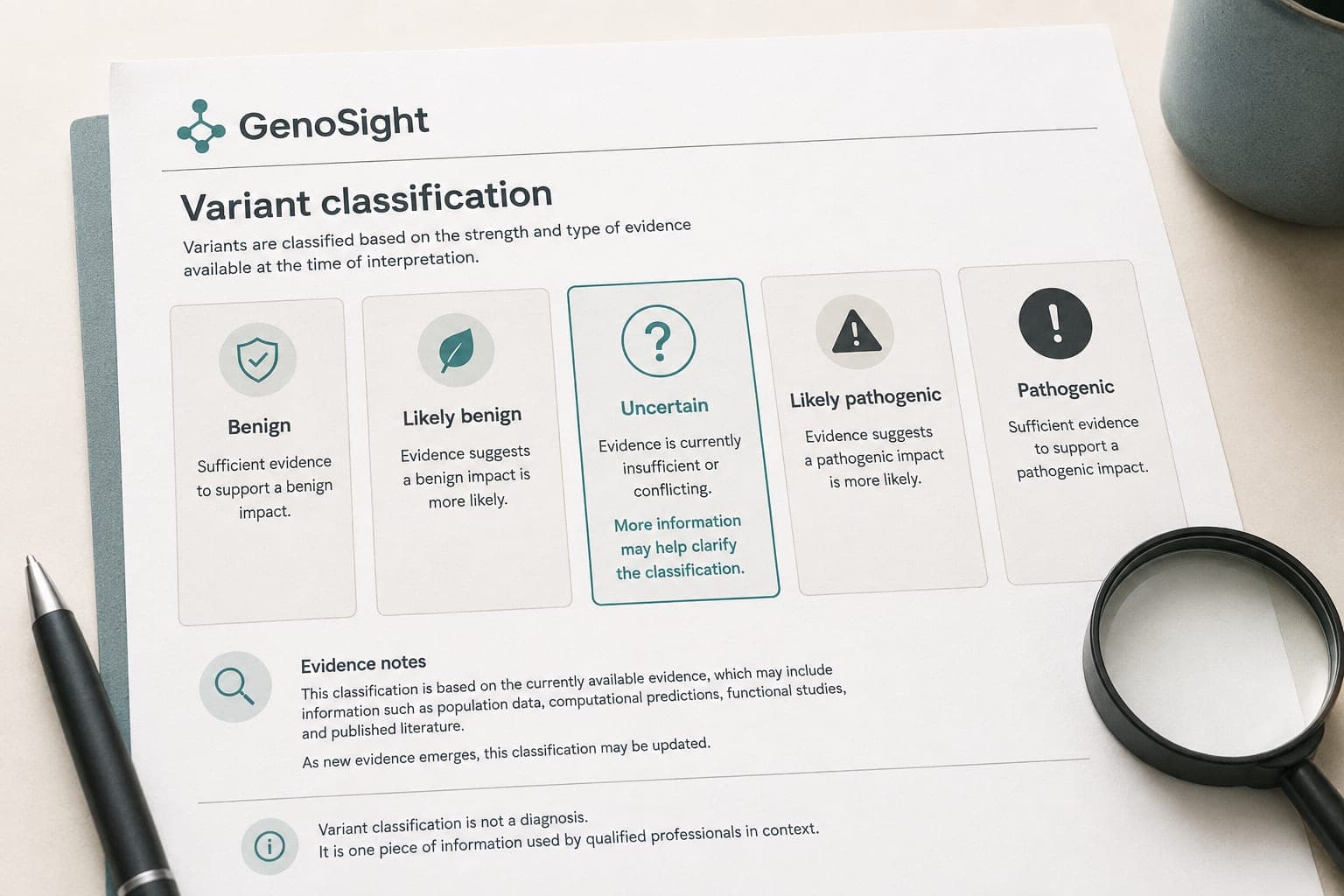
A variant of uncertain significance, or VUS, is a genetic variant whose connection to a particular health condition remains unresolved. A VUS does not establish a diagnosis and should not, by itself, determine treatment or screening. The useful next step is to clarify the original result and its clinical context with the professional responsible for the test.
Finding those words in a report can be unsettling. They describe a limit in the evidence, rather than a prediction that something bad will happen. Before searching for a disease name, separate three questions: was the variant measured accurately, how has the variant been classified, and what does the finding mean for the person tested?
What does the uncertain classification describe?
The NHGRI definition of VUS explains that available information cannot establish whether a variant contributes to disease. More evidence may eventually clarify its significance. The classification is about the relationship between a particular genetic change and a condition; the word uncertain is not a personal risk percentage.
Clinical variant interpretation commonly distinguishes benign, likely benign, uncertain significance, likely pathogenic and pathogenic. The ACMG and AMP consensus framework sets out these categories and evidence-based interpretation principles. A VUS sits in a different category from a likely pathogenic finding. It should not be rounded up to a positive result because a report also mentions a serious condition.
Nor should uncertain be silently rewritten as harmless. Keep the actual wording. A careful explanation can acknowledge that the result remains unresolved while avoiding a diagnosis that the evidence does not support.
First establish where the result came from
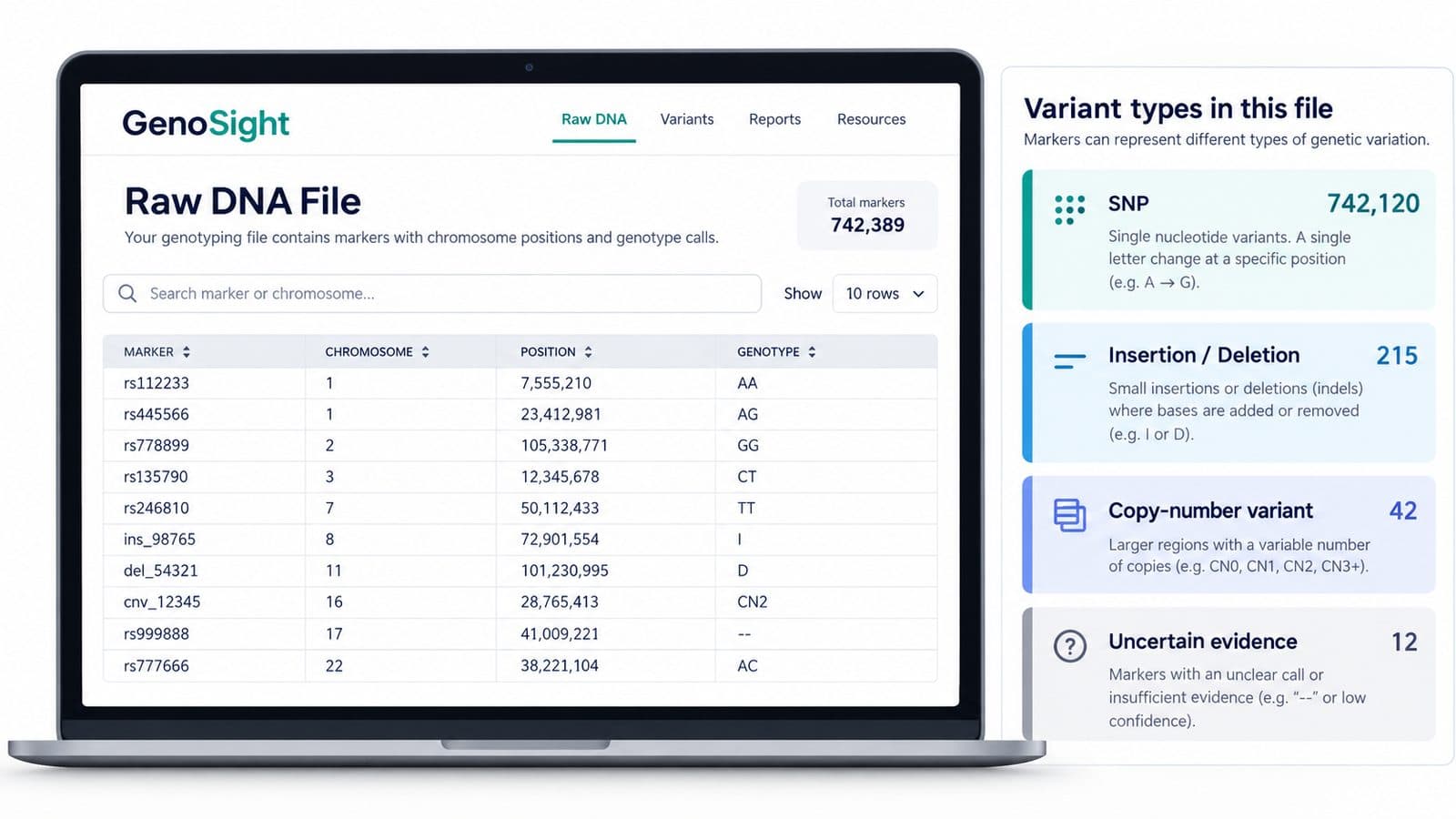
A clinical laboratory report and a third-party annotation of a consumer raw DNA file are different starting points. When a website matches an uploaded row to a database entry, the database classification does not independently verify the measurement in that uploaded file. A matching name alone also cannot establish that two records describe the same change.
If you started with an export, retain the original file and the testing company's documentation. Our raw DNA download guide explains how to obtain that original. Avoid repeatedly editing the file or copying isolated letters between websites: the surrounding marker and reference information can be needed to understand a discrepancy.
Build a small record for the professional reviewing the result:
- The original laboratory or testing company and report date.
- The exact variant description and the condition attached to its classification.
- Whether the finding came from the laboratory report or a later interpretation service.
- The classification date and any explanation or limitations included in the report.
- The question that prompted testing, plus relevant personal and family history.
Keep this record private. A public forum does not need your complete genetic file, name, date of birth or family members' medical details to explain a technical term. Sharing a redacted question with the appropriate service is usually a more focused first step than uploading the entire file somewhere else.
Why a database search may show different answers
Databases can contain assessments from different submitters and dates. A search result that displays a condition name is not a diagnosis. Read the record underneath the search result, including the variant, condition, evidence and review information.
ClinVar's review-status documentation explains that stars describe the review process and agreement behind an assertion. Stars are not a scale for how dangerous a variant is. An expert-panel assessment and a single submitter's assertion represent different review situations; neither turns a person's unrelated raw-data match into a clinical conclusion.
For example, imagine an old interpretation page showing VUS while a newer laboratory report uses different wording. Save both dates and descriptions for review. Do not simply select the more alarming label, or the one that feels reassuring. First confirm that the records describe the same variant and condition. That comparison is a task for careful interpretation, not a vote between websites.
What can change, and what should wait?
Genomics England explains reclassification as a process of gathering evidence, including observations in other people and investigation of a variant's effects. A more confident explanation requires better evidence. A newly generated AI summary cannot supply missing laboratory or clinical evidence simply by sounding certain.
The NHS Genomics Education guidance distinguishes family studies used to help classify a variant from predictive testing intended to guide relatives' medical management. A specialist may consider whether additional investigation would be informative. That is different from telling every relative to act as though the VUS were disease-causing.
Ask the testing service how updates are handled and whether you should contact it again. Do not assume that every database change automatically produces a message to you. Also ask who should answer questions if the original clinician or laboratory changes. Save the response with the report so the follow-up plan is understandable later.
Questions worth taking to the appointment
Bring a short list rather than a stack of alarming screenshots: Is this an original clinical finding? Does any part need confirmation? Which condition is the classification about? Does my history suggest evaluation independently of this result? Who is responsible for discussing future updates?
Health decisions should be made with the relevant clinician using the whole clinical picture. Continue to seek appropriate care for symptoms or family-history concerns even when a genetic result is uncertain. The VUS label neither proves a cause nor removes other reasons to investigate.
GenoSight's educational material can help explain report terminology. You can inspect the sample report before deciding whether that style of explanation is useful. An educational interpretation does not replace clinical assessment or settle an unresolved variant classification.
See how GenoSight explains genetic information
Explore the sample report to understand the educational format and its limitations.