snps explained
Heterozygous Genotype: Reading Two Different Alleles
Learn what a heterozygous genotype means in a raw DNA row, how it differs from homozygous, and why the label alone does not establish a health finding.
GenoSight Team · September 24, 2026 · 4 min read
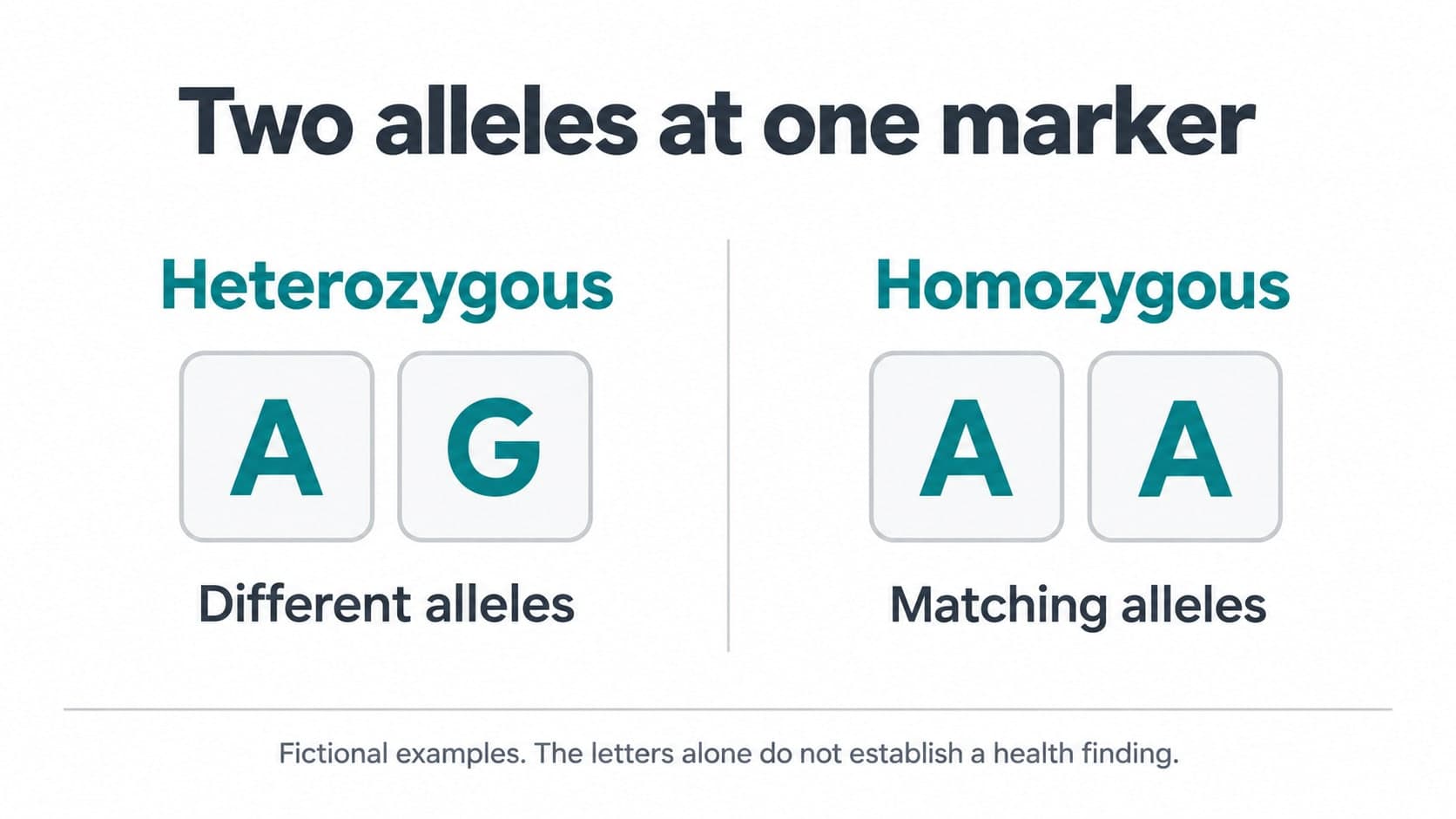
A heterozygous genotype means that two alleles at a particular locus are different. In a valid two-allele call at a single diploid marker, AG is heterozygous and AA is homozygous. Neither label, by itself, tells you whether the result affects your health.
The distinction is useful when reading a raw DNA row because it separates a description of the reported alleles from an interpretation of those alleles. You can correctly recognize a heterozygous pair and still have no evidence that the marker is clinically important. Keep those two questions separate as you read.
Evidence checked September 24, 2026. All letter examples below are fictional teaching examples, not results for a named variant or person.
What the word describes
The National Human Genome Research Institute defines heterozygous in terms of different versions of a genomic marker. Homozygous describes matching versions. The description belongs to the particular marker under discussion, not to your entire genome as a single category.
A person can have a heterozygous call at one marker and a homozygous call at another. That is not a contradiction. Saying only "I am heterozygous" leaves out the location that gives the statement meaning. A useful note names the marker and preserves the result as reported.
The National Cancer Institute's definition of heterozygous genotype likewise focuses on different alleles at a locus. The word is about the relationship between the alleles. It is not a category such as benign, uncertain or pathogenic, which concerns the interpretation of a variant.
Read a fictional raw-data example
Imagine that an export contains these deliberately invented entries. Each example assumes a reliable two-allele call at one diploid marker. The placeholder names do not refer to real database records.
| Marker placeholder | Reported alleles | Description | What remains unknown |
|---|---|---|---|
| Example marker one | AG | Heterozygous: the alleles differ | Any health meaning |
| Example marker two | AA | Homozygous: the alleles match | Any health meaning |
| Example marker three | CT | Heterozygous: the alleles differ | Any health meaning |
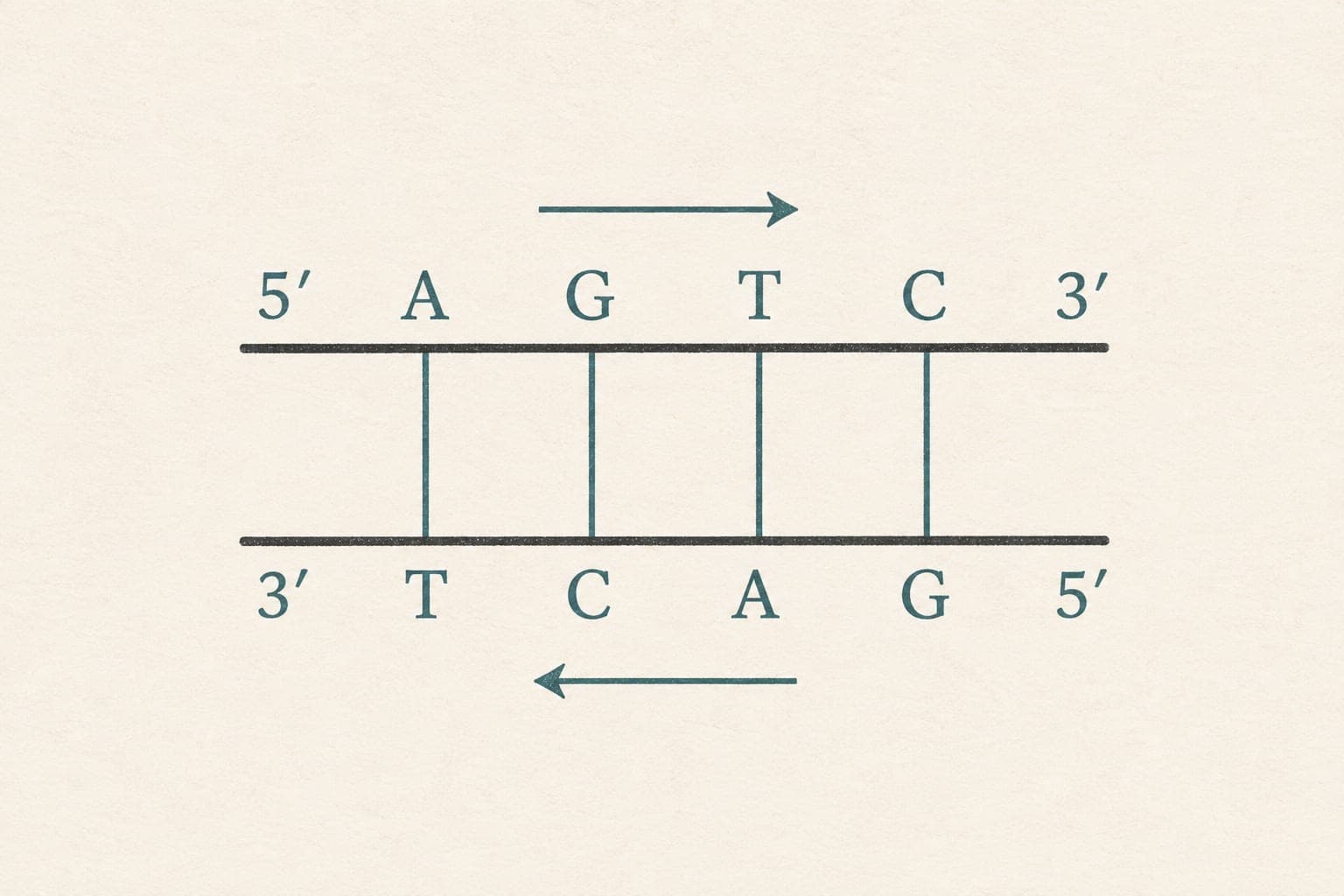
The A and G in the first row are the two reported alleles at one marker. They are not an assertion that A pairs with G across a DNA double strand. A genotype row and a drawing of complementary strands describe different things. Confusing those representations can make a correct result look like an error.
Do not extend the table to an unclear or missing call. If a file uses a special symbol, a single letter or a different representation, check its documentation before treating that entry as a standard two-allele example. Preserve the original export rather than replacing unfamiliar symbols with a guess.
Different alleles do not establish a disease or carrier finding
Two letters can differ without one being labeled harmful. The exact location, the alleles and the evidence about a particular variant matter. A generic search for AG, for instance, discards the marker information needed to understand which result is being discussed.
MedlinePlus explains that inheritance patterns differ. For some single-gene conditions, one relevant altered copy can be sufficient; for others, relevant variants affect both copies. Many health conditions involve multiple genes and environmental influences instead. Those differences are why the term heterozygous cannot, by itself, settle a health interpretation.
Likewise, calling every heterozygous result a carrier result is not justified. Carrier interpretation needs a specific variant and relevant inheritance context. Do not assume that a second allele is harmless, or that the first is harmful, simply from the order or appearance of the letters in a table.
If a report uses a classification such as uncertain significance, read that classification separately from the genotype. Our guide to a VUS result discusses why uncertainty is not confirmation. The same discipline applies here: retain the uncertainty rather than translating an unfamiliar label into a more definite claim.
Keep the evidence with the row
Before comparing a raw call with an explanation elsewhere, save the marker identifier, chromosome and position, reported alleles, provider and reference information together. A screenshot containing only the two letters is usually missing the very context you need to reproduce the comparison.
Use the raw DNA download guide to retrieve the untouched export. If the comparison involves different assemblies, check the reference-build guide before interpreting a position mismatch. Those checks do not create a medical conclusion; they help establish whether you are comparing the same thing.
You do not need to post your complete genetic file publicly to ask what a term means. A focused question can identify the label you are trying to understand without sharing unrelated markers. For a question about an actual result, choose an appropriate private route and follow the recipient's instructions about what information is needed.
What to ask about an interpretation
When a report attaches a health statement to a heterozygous result, ask which exact variant the statement concerns, which source supports it and whether the evidence applies to that reported result. Ask whether the statement describes a measured genotype, a variant classification or a broader association. Those are different kinds of information.
It is also reasonable to ask what remains uncertain and whether an important result needs professional review or confirmation. A longer explanation does not remove the need for those answers. Avoid treating the presence of a technical term as proof that the interpretation is complete.
For an educational example, you can see a GenoSight sample report before deciding whether to share an original file. For clinically important concerns, discuss the original result with an appropriate healthcare professional. Recognizing different alleles is a useful reading skill, not a reason to change treatment or infer a diagnosis.
See a sample report
Read an example of educational interpretation before uploading an original DNA file.