methylation
DNA Methylation Genes: What Raw DNA Can Show
Learn which methylation-related genes may appear in a consumer raw DNA file, what those variants can and cannot tell you, and when lab testing matters.
GenoSight Team · October 2, 2026 · 7 min read
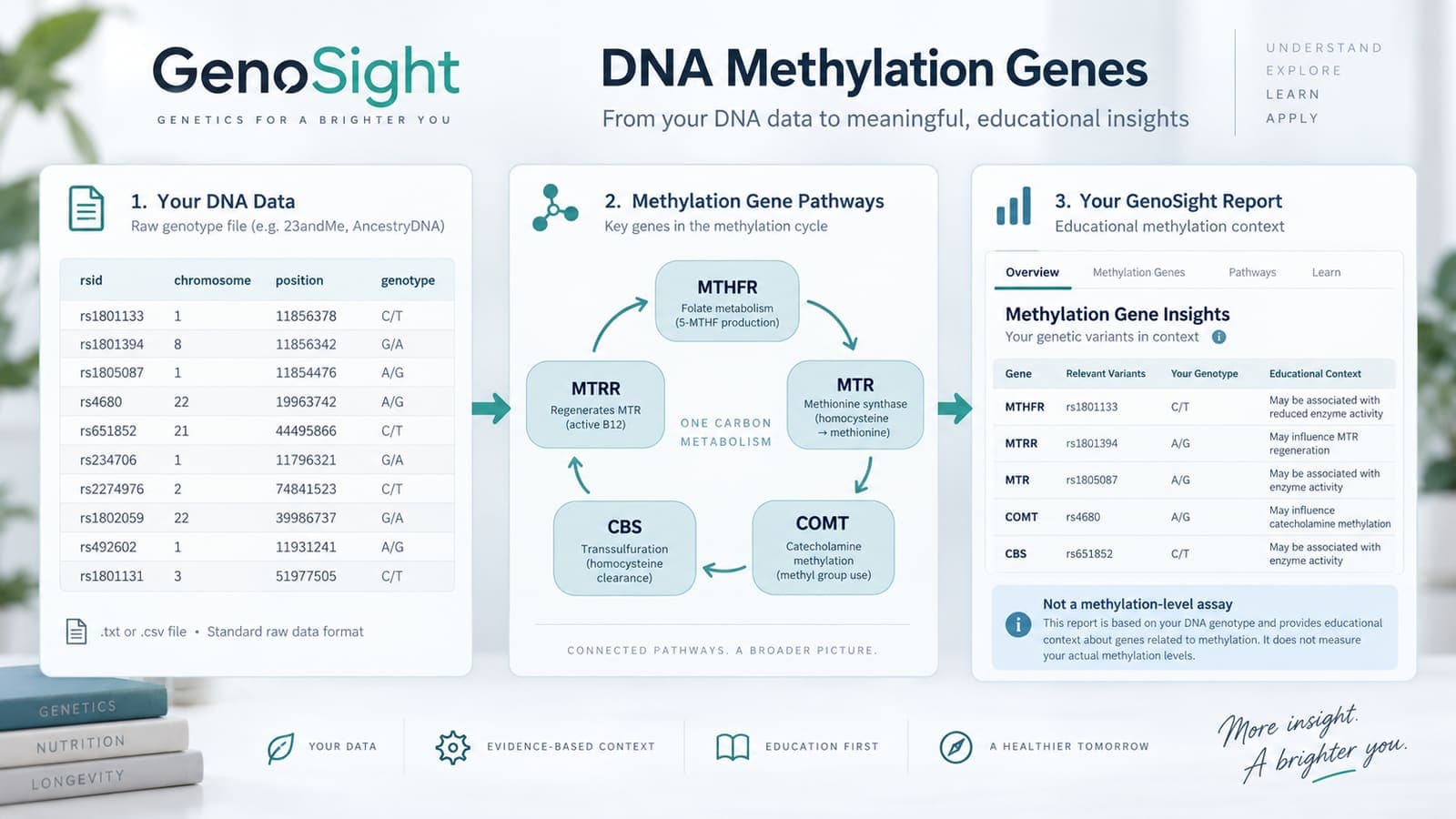
DNA methylation genes are genes that help create, use, or respond to methyl groups in pathways such as folate metabolism, methionine recycling, homocysteine handling, and catecholamine breakdown. A consumer raw DNA file can sometimes show inherited variants in genes such as MTHFR, MTRR, MTR, COMT, CBS, BHMT, AHCY, and PEMT. A raw DNA file does not measure your current DNA methylation levels, epigenetic age, homocysteine, folate, or B12 status.
That distinction matters because two different things often get called "methylation testing":
| Question | What is being measured? | What it can tell you | What it cannot tell you |
|---|---|---|---|
| Inherited methylation-related variants | DNA sequence letters at selected markers | Whether your file contains variants in pathway genes such as MTHFR or COMT | Your current methylation level, nutrient status, diagnosis, or supplement dose |
| Epigenetic DNA methylation | Chemical methyl tags on DNA at measured sites | How methylation patterns differ in the sampled tissue at that time | Your inherited genotype at every methylation-pathway gene |
| Blood or urine chemistry | Molecules such as homocysteine, folate, B12, MMA, or related metabolites | A current biochemical clue to discuss with a clinician | Which inherited variant caused the result by itself |
Why the word methylation gets confusing
DNA methylation is an epigenetic process. The CDC explains epigenetic changes as changes that affect how the body reads DNA without changing the DNA sequence itself. DNA methylation is one example: a methyl group is added to DNA, and that chemical tag can influence whether a gene is more or less active in a specific cell context.
The NHGRI glossary entry for methylation puts the same idea more simply: methylation in DNA can alter gene expression. A detailed review in Neuropsychopharmacology describes DNA methylation as a regulated process involving DNA methyltransferases and methylated cytosines, with effects that vary by genomic context and cell type (Moore, Le and Fan, 2013).
Consumer raw DNA files are different. A 23andMe, AncestryDNA, or MyHeritage raw file usually reports genotype calls at selected inherited markers. It may show something like rs1801133 C/T for MTHFR C677T or rs4680 A/G for COMT Val158Met. Those rows are DNA sequence variants, not methyl tags measured on DNA.
Quick boundary
If a tool uses your consumer raw DNA file, it is usually interpreting inherited variants related to methylation pathways. It is not measuring your current epigenetic methylation pattern unless a separate methylation assay was performed.
Methylation-related genes people often look up
The useful way to read a raw file is pathway by pathway, not one variant at a time. A single marker can be interesting, but methylation biology depends on folate status, B12, B6, choline, kidney function, medications, pregnancy status, diet, alcohol intake, inflammation, and many other non-genetic factors.
Commonly discussed genes include:
| Gene | Pathway context | Raw-DNA interpretation boundary |
|---|---|---|
| MTHFR | Helps convert folate into 5-MTHF, a methyl donor used in methionine recycling | Variants such as C677T and A1298C can change enzyme activity, but genotype alone does not prove folate deficiency or high homocysteine |
| MTR | Uses 5-MTHF and B12 to help recycle homocysteine to methionine | A variant can be one clue, but current B12, folate, and homocysteine labs matter more for clinical decisions |
| MTRR | Helps regenerate active B12 for methionine synthase | A raw DNA result does not show whether B12 status is adequate today |
| COMT | Uses methyl groups while breaking down catecholamines and catechol estrogens | COMT variants can affect enzyme activity, but they do not diagnose anxiety, estrogen problems, or supplement needs |
| CBS | Routes homocysteine toward transsulfuration | Individual CBS variants are often overinterpreted online; clinical context and lab values are essential |
| BHMT | Supports a betaine-dependent route for homocysteine remethylation | Raw DNA can show selected variants, not choline or betaine sufficiency |
| AHCY | Handles S-adenosylhomocysteine metabolism in the methylation cycle | A genotype is not a direct measure of methylation load |
| PEMT | Helps synthesize phosphatidylcholine and intersects with choline demand | Variants can inform nutrition context, not prove a need for a specific supplement |
The most familiar example is MTHFR C677T, also known as rs1801133. NCBI lists MTHFR as Gene ID 4524, and the NIH Genetic Testing Registry describes rs1801133 as a common C677T polymorphism in that gene. It is worth understanding, but it is not a diagnosis. Someone with a reduced-activity MTHFR genotype may still have normal homocysteine and adequate folate status. Someone without the common MTHFR variants can still have nutrition, medication, kidney, thyroid, pregnancy, alcohol, or inflammatory reasons for abnormal labs.
COMT is another common example. NCBI lists COMT as Gene ID 1312, and consumer methylation reports often discuss COMT because catechol-O-methyltransferase uses methyl groups while metabolizing catechol compounds. That makes COMT relevant context, but it does not make a raw DNA result a mood diagnosis or supplement instruction.
What a raw DNA file can do well
A raw DNA file is useful for identifying inherited markers that should be interpreted cautiously. It can help answer questions such as:
- Does my file include common methylation-pathway markers like MTHFR C677T or COMT Val158Met?
- Are the variants being discussed actually present in my file, or did a tool infer them from a partial dataset?
- Which report area should I review first: folate and B vitamins, detox and methylation context, mental wellbeing, or medication-response research?
- Which findings are worth summarizing for a clinician because they intersect with symptoms, medications, family history, or abnormal labs?
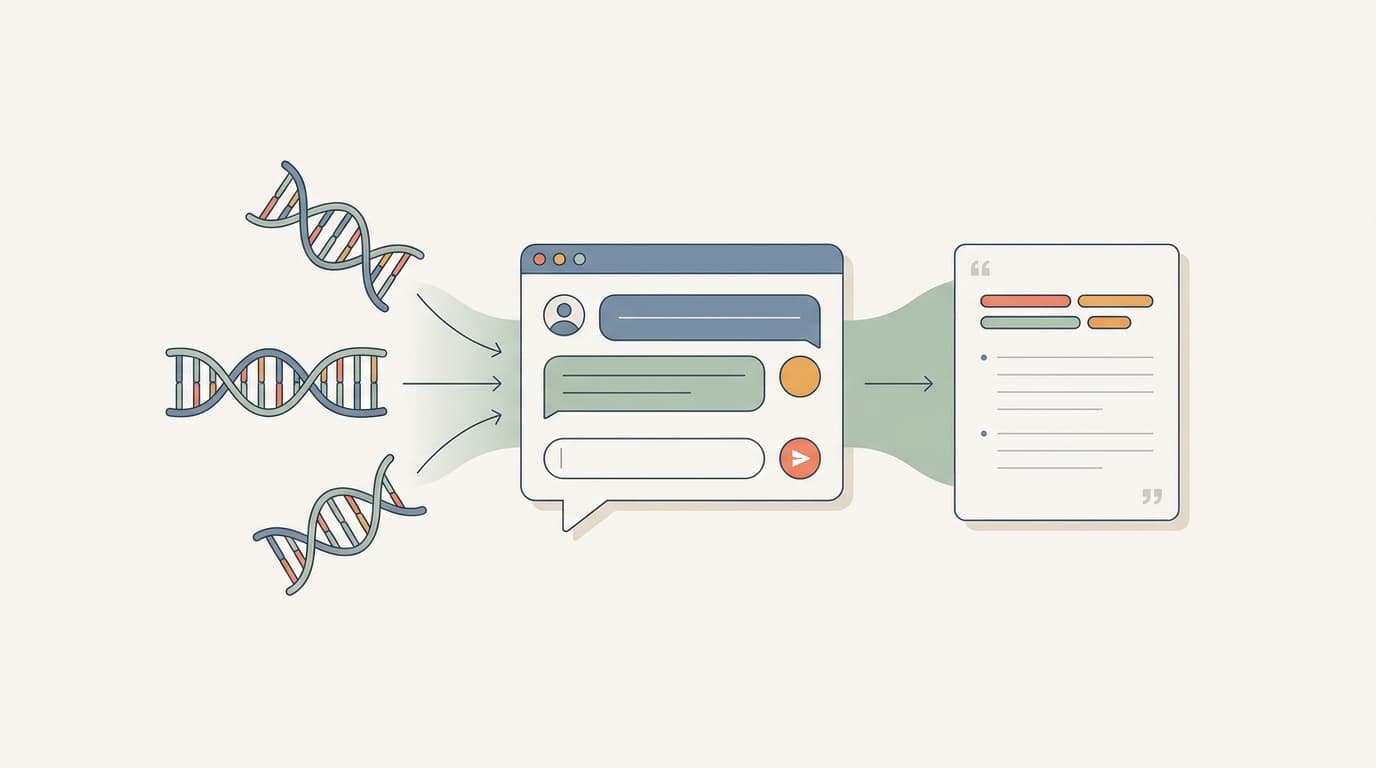
That is the GenoSight use case. GenoSight reads a compatible raw file, extracts selected pathway-relevant variants, and frames them inside educational reports with citations and caveats. The Detox and Methylation report is meant to organize context around genes such as MTHFR, COMT, MTR, MTRR, CBS, and related pathways. It does not measure methylation levels, diagnose a methylation disorder, or prescribe supplements.
For file handling basics, start with how to download raw DNA data. For the broader privacy model, read raw DNA data privacy after upload. For source discipline, see where GenoSight insights come from.
What a raw DNA file cannot prove
Raw DNA interpretation gets risky when a variant is treated as a lab result. A consumer genotype file generally cannot tell you:
- whether your DNA is currently over-methylated or under-methylated;
- your homocysteine, folate, B12, B6, methylmalonic acid, or choline status;
- whether you should start, stop, or dose a supplement;
- whether symptoms such as fatigue, anxiety, insomnia, miscarriage, neuropathy, or brain fog are caused by a methylation gene;
- whether a medication, pregnancy plan, or medical treatment should change.
Those questions require clinical context. Depending on the situation, a clinician may consider blood chemistry, medical history, medications, diet, pregnancy status, kidney function, family history, or a purpose-built clinical test. Raw DNA can help you ask a better question. It should not become the answer by itself.
How to read methylation gene results safely
Use a four-step review:
- Confirm the marker. Start with the exact rsID and genotype from an untouched raw file. Do not rely on a screenshot or a re-saved spreadsheet if the original export is available.
- Separate inherited variant from current state. Write down whether you are looking at genotype, epigenetic methylation, or blood chemistry. Mixing these categories is the main source of bad advice.
- Check the pathway and the evidence. MTHFR, MTRR, MTR, COMT, CBS, BHMT, AHCY, and PEMT belong to related but different roles. A variant in one gene should not be turned into a whole-cycle conclusion.
- Bring clinical questions to a professional. If the issue involves pregnancy, medication response, abnormal labs, neurological symptoms, clotting history, depression, or persistent fatigue, use the raw DNA result as discussion context rather than a treatment plan.
Review methylation-related variants in context
GenoSight can turn a compatible 23andMe, AncestryDNA, or MyHeritage raw file into an educational Detox and Methylation report with citations, caveats, and a clear boundary between genotype and lab results.
The practical takeaway
DNA methylation genes can be useful to review when you already have a raw DNA file, especially if you want organized context around folate, B vitamins, COMT, homocysteine pathways, and related report areas. The safe interpretation is narrow: inherited variants are clues, not measurements of your current methylation state.
If your goal is learning, a raw DNA report can help. If your goal is diagnosing a symptom, changing medication, planning pregnancy care, or choosing supplements, pair the genotype context with current labs and qualified clinical guidance.
Sources
- CDC - Epigenetics, Health, and Disease, accessed October 2, 2026.
- NHGRI - Methylation, accessed October 2, 2026.
- Moore LD, Le T, Fan G. DNA methylation and its basic function. Neuropsychopharmacology. 2013.
- NCBI Gene - MTHFR methylenetetrahydrofolate reductase, accessed October 2, 2026.
- NCBI Gene - COMT catechol-O-methyltransferase, accessed October 2, 2026.
- NIH Genetic Testing Registry - MTHFR thermolabile polymorphism, accessed October 2, 2026.
- GenoSight - How to download raw DNA data.
- GenoSight - Raw DNA data privacy after upload.