snps explained
Chat With Your DNA: Better Than Static Reports
Findings-grounded DNA chat answers follow-up questions from your actual report, with citations and limits that static genetic reports cannot provide.
Sebastian Thorp · May 7, 2026 · 6 min read
In short
A static genetic report is the answer to the questions you knew to ask when you uploaded the file. The questions that actually matter are the ones that come up while you're reading the report — and those need a different surface. "Chat with your DNA" means a conversational interface grounded in your specific findings + profile, where each follow-up answer cites the same primary sources (ClinVar, PharmGKB, GWAS Catalog) the report itself uses. It's not a chatbot wrapped around a wiki. It's the part of AI DNA analysis that earns its keep.
Why static reports run out of road
A genetic-health report is a snapshot. You read it once, get a sense of which variants stood out, and then real life happens.
Two weeks later, your prescriber suggests a new SSRI and you remember something about CYP2C19 metabolism. You don't remember what star-rating the evidence had. You don't remember if the report mentioned dose adjustments. The report is still in your inbox somewhere, but it's not searchable the way the question in your head is searchable.
This is the gap that conversation closes.
A findings-grounded chat lets you ask the question as it forms — "how is my CYP2C19 result described in the GWAS literature?" — and get an answer that pulls from your specific findings, your reported supplements, and the same primary sources the original report cited.
What "chat with your DNA" technically means
The phrase gets used three ways. They're not the same thing:
- A chatbot wrapped around a static FAQ. Asks pre-canned questions, returns pre-canned answers. Generic. The "DNA" part is mostly aesthetic.
- An AI that's seen your report once and now answers from memory. Marginally better. Loses precision over a long conversation as the model forgets context.
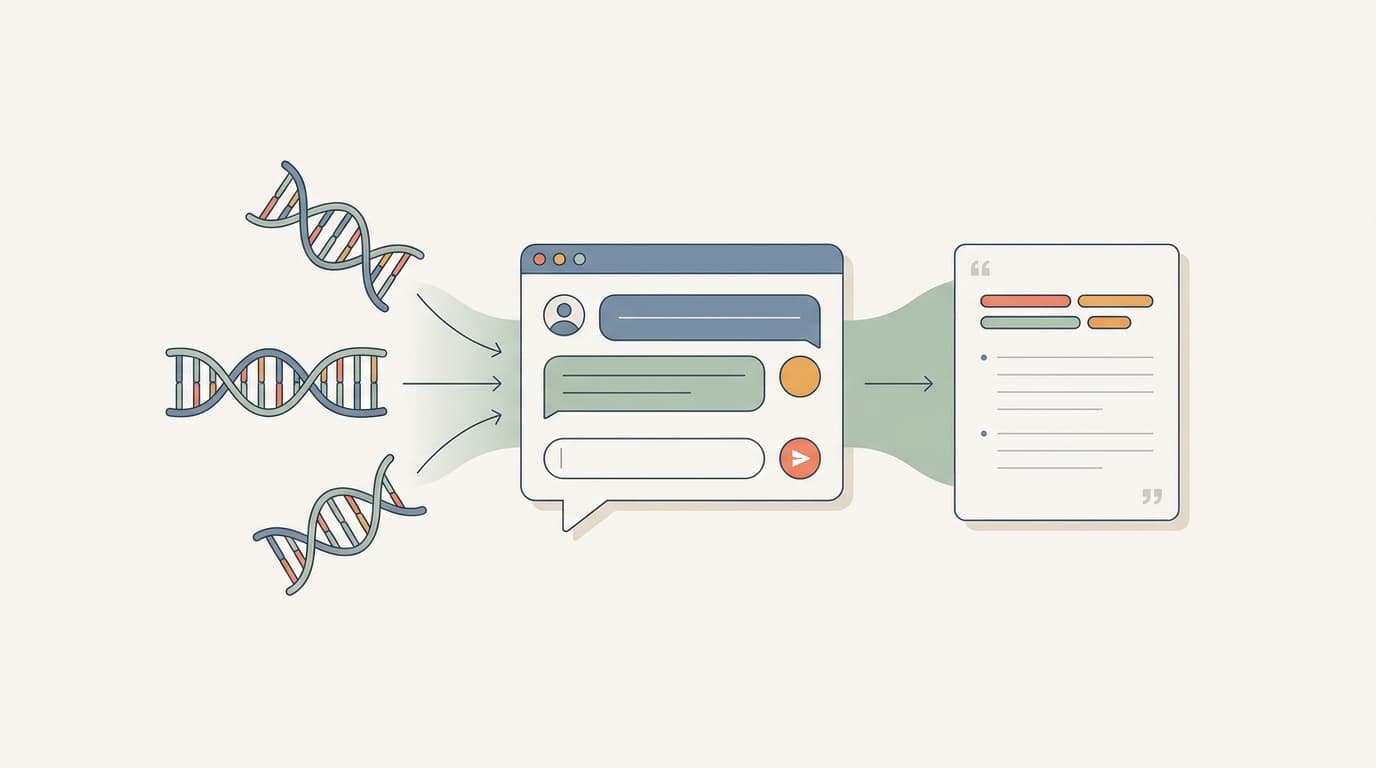
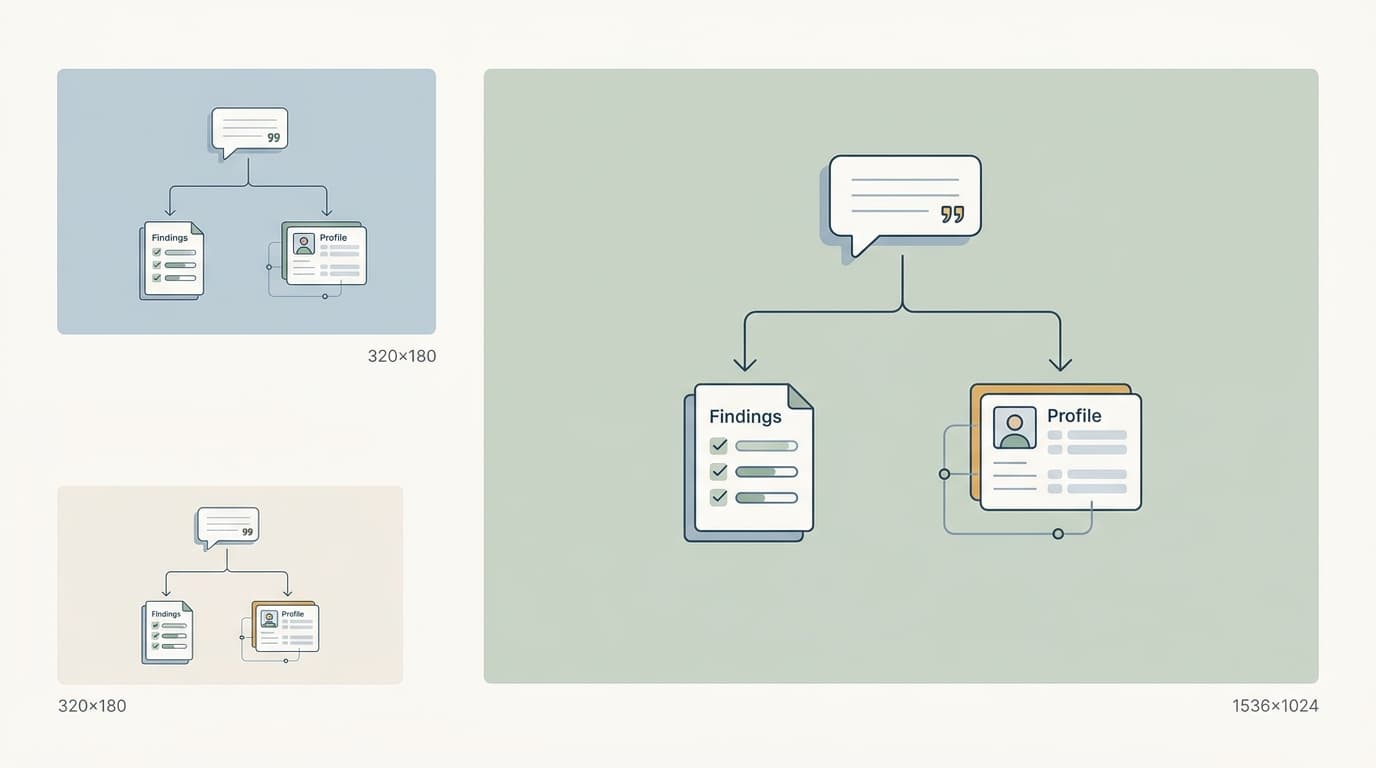
- A model with live retrieval against your structured findings + profile. Every answer pulls fresh from your actual data, citing the same primary sources the report does. This is the only version that earns the label.
The third one is what GenoSight runs and what this post is about.
What changes when chat is grounded in your actual findings
Three things shift. They're individually small and collectively the difference between "useful conversation" and "AI theater."
Specificity replaces generality
Generic AI: "MTHFR C677T may affect folate metabolism in some individuals."
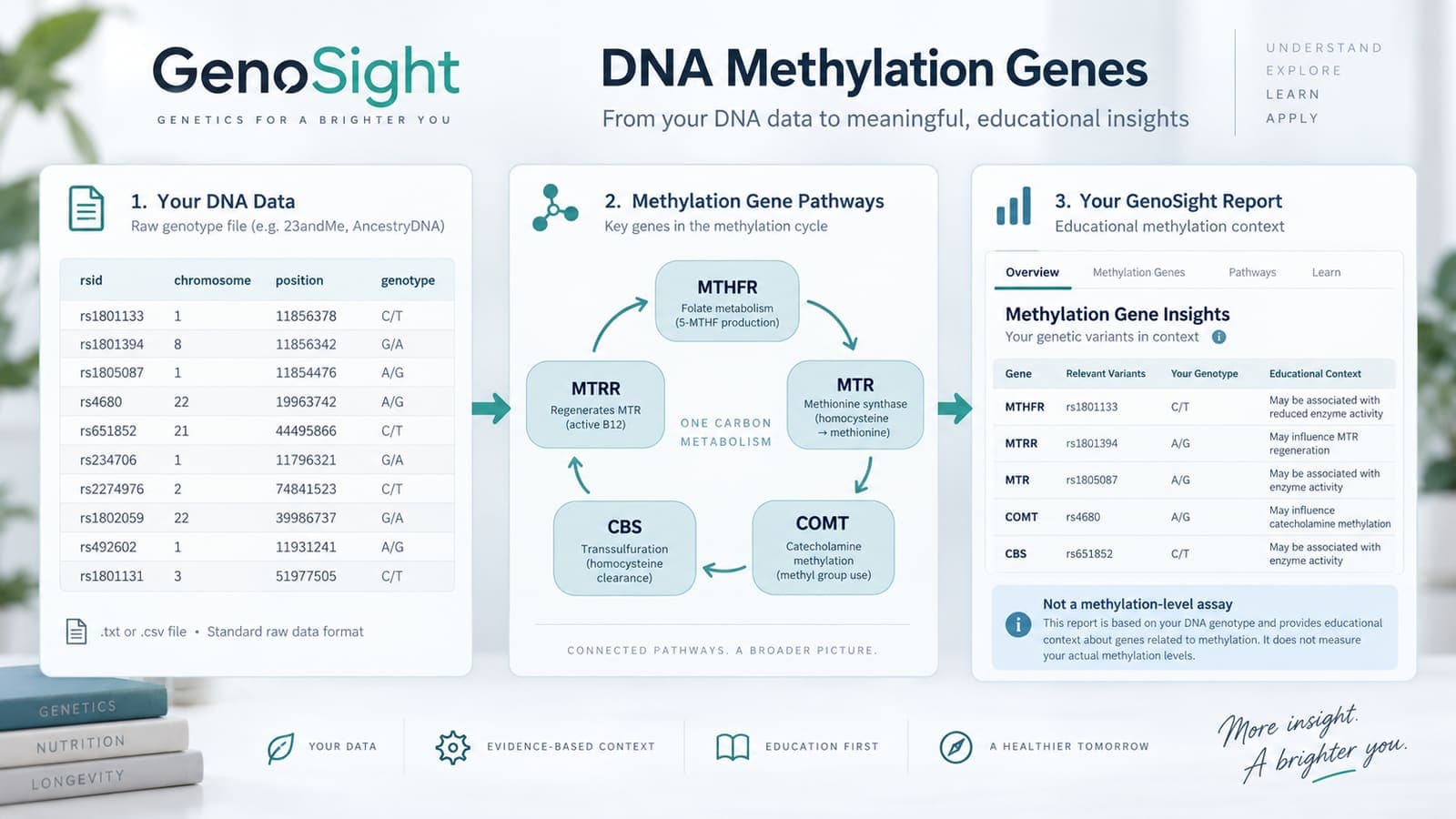
Findings-grounded AI: "Your rs1801133 result is heterozygous CT, which is associated with roughly 30% reduced MTHFR enzyme activity in the GWAS Catalog literature. Combined with your reported folic acid supplementation, you may want to discuss with your provider whether a methylated form (e.g. methylfolate) is more appropriate."
Same factual content. The first version is a definition. The second is a decision aid.
Citations stay attached
Every answer in a properly-grounded chat carries the same citation discipline as the original report. ClinVar review-confidence stars, PharmGKB evidence levels, study power notes — they all surface inline so you can verify.
This matters more than it sounds. Without inline citations, follow-up answers degrade into confident-sounding speculation that's indistinguishable from hallucination. With them, you can see which claims are backed by Level 1A drug-gene evidence and which are backed by single underpowered studies.
Confidence calibration shows up in the answer
Variant interpretation has a confidence spectrum. ClinVar's review-confidence stars range from zero (single submitter, conflicting interpretations) to four (practice guideline). PharmGKB's evidence levels run from 1A (clinical guideline) to 4 (preliminary).
A grounded chat surfaces this calibration in every answer. "Your APOE genotype is well-studied (multiple Level 1A submissions)" reads differently than "your reported variant has a single ClinVar submission with one star — interpretation may evolve." The user gets to weight findings appropriately, instead of treating every claim as equally settled.
Five real questions, real answers
These are slightly-edited versions of questions GenoSight users have asked their findings chat. The point isn't the questions — it's that each one is the kind of thing a static report can't anticipate.
"What's the difference between methylated and non-methylated B12 in general?" Methylcobalamin (methylated) is the form that participates directly in the methionine synthase reaction. Cyanocobalamin (non-methylated) requires conversion. For people with reduced MTHFR activity, the methylated form may be preferable because the upstream methylation cycle is already constrained — but this is general background, not specific to your findings. Ask your healthcare provider about your specific situation.
"How is my CYP1A2 result described in the GWAS literature?" The chat pulls your specific rs762551 genotype, surfaces the relevant GWAS associations (caffeine clearance, breast cancer risk in some studies — with effect sizes and study power), and links to the underlying citations.
"What does ClinVar's two-star confidence actually mean for this variant?" A two-star review-confidence rating in ClinVar means multiple submitters agree on the interpretation. It's a stronger signal than a single submitter, weaker than expert-panel (three stars) or practice guideline (four stars). Practical implication: the interpretation is reasonably stable but isn't yet a clinical guideline.
"Which of my findings would be most useful to mention at my next clinical appointment?" The chat ranks your findings by clinical actionability (PharmGKB Level 1A drug-gene interactions first, then variants with practice-guideline support, then well-studied lifestyle SNPs), pulling from your specific report rather than a generic priority list.
"My new prescription is sertraline — anything in my report relevant?" Sertraline is a CYP2C19 substrate. The chat surfaces your CYP2C19 result with PharmGKB Level 1A evidence about poor / intermediate / extensive / ultra-rapid metabolizer phenotypes, the typical implications for SSRI dosing, and a recommendation to bring this information to your prescriber. It explicitly does not adjust your dose or contradict prescriber guidance.
What the chat can't and won't do
A grounded findings chat is a useful tool. It is not — and shouldn't be — a clinician.
GenoSight's chat is read-only by default. The single tool that can propose a change to your supplement stack (propose_stack_change) renders a confirmation card before anything is written. There are no silent mutations.
The chat will not:
- Diagnose conditions. Variant associations describe statistical relationships in studied populations, not deterministic outcomes.
- Prescribe or adjust medications.
- Override or contradict clinical guidance you've received from a healthcare provider.
- Make claims that aren't traceable to a primary source.
The constraints are baked into the prompt and reinforced by validators that re-check every claim against the underlying findings. Refusal patterns are intentional, not a limitation to work around.
Why this matters for "AI DNA analysis" overall
The chat is the part of AI DNA analysis where the AI most clearly does something the alternatives can't.
Manual interpretation can produce an excellent static report. Static reports can be detailed and well-cited. What manual interpretation can't do — economically — is sit with you for an hour answering your specific follow-up questions every time something new comes up in your health.
That's what a grounded chat does. Not by being smarter than a geneticist; by being available at 11pm when you're reading your prescription bottle and remember something from a paragraph in your report.
Try the findings chat
Upload your DNA file, get your personalized report, then ask follow-up questions grounded in your specific findings. 250 free signup credits.
Medical disclaimer
GenoSight provides educational information about your genetic data and chat responses grounded in your specific findings. It is not a medical diagnosis, treatment, or cure. Always consult your healthcare provider before making decisions based on this information.
Key takeaways
- A static genetic report is the answer to the questions you knew to ask. The most useful questions are the ones that come up while you're reading.
- "Chat with your DNA" only earns the label when the AI has live retrieval against your specific findings + profile, citing the same primary sources the original report uses.
- Specificity, citation discipline, and confidence calibration are the three things grounded chat does that generic AI doesn't.
- The chat should be read-only by default. Any tool that mutates your supplement or medication stack should require explicit user confirmation.
- It's a useful tool, not a clinician. Variant associations are statistical, not deterministic.