snps explained
VDR Gene Mutation: What a Raw DNA Result Means
Learn what the VDR gene does, why rare pathogenic variants differ from common markers, and what a consumer raw DNA result cannot diagnose or treat.
Sebastian Thorp · November 10, 2026 · 4 min read

The VDR gene makes the vitamin D receptor, which helps cells respond to the active form of vitamin D. A consumer raw DNA file may contain some VDR marker calls, but those calls do not diagnose vitamin D deficiency, hereditary vitamin D-resistant rickets, or tell someone which supplement or dose to take.
Rare disease-causing VDR variants are different from the common polymorphisms often discussed in raw-DNA communities. The useful next step is to keep the original marker row, check what kind of evidence a source actually describes, and use clinical testing or care for a health question.
What the VDR gene does
VDR is the gene for the vitamin D receptor. The receptor binds calcitriol, the active form of vitamin D, and helps regulate genes involved in calcium and phosphate balance. Those minerals matter for normal bone and tooth development (MedlinePlus Genetics).
The gene is on chromosome 12 and has the approved symbol VDR (NCBI Gene). That basic biology explains why VDR appears in discussions of vitamin D. It does not mean that every VDR marker in a consumer file explains a person's vitamin D level, symptoms, or response to a supplement.
Rare pathogenic variants are not the same as common markers
Pathogenic variants are changes with evidence that they can cause disease. Pathogenic VDR variants can cause vitamin D-dependent rickets type 2A, also called hereditary vitamin D-resistant rickets. This rare condition can impair signaling through the receptor and affect calcium and phosphate handling (MedlinePlus Genetics).
A clinical study of affected patients describes hereditary vitamin D-resistant rickets as an autosomal-recessive disorder caused by VDR mutations and reports clinical and laboratory features in that setting (Malloy et al.). That evidence concerns people evaluated for a rare disorder. It should not be transferred to a common marker simply because the marker is located in VDR.
| Evidence layer | What it can show | What it cannot show by itself |
|---|---|---|
| Consumer raw DNA row | A provider's reported call at a selected marker | A diagnosis, current vitamin D status, or a complete clinical variant assessment |
| Gene reference | What VDR normally does and where it is located | Whether a specific reported marker is pathogenic for one person |
| Clinical variant evidence | Evidence about an exact variant and condition | Whether the evidence fits a consumer-chip call or a person's health history |
| Blood test and clinical evaluation | Vitamin D status and relevant clinical context | A complete explanation from one isolated laboratory value |
The genetic variants guide explains why a marker, a genotype, a variant claim, and a clinical interpretation are different things. The genotyping versus sequencing guide explains why a consumer array is not a complete genome test.
What a raw DNA file can and cannot answer
A compatible consumer raw DNA file is usually a table of selected markers. If it includes a VDR row, the row can be a starting point for a carefully sourced question. It is not proof that the file covers every relevant VDR variant, and it does not measure how much vitamin D is in the blood.
The NIH Office of Dietary Supplements identifies serum 25-hydroxyvitamin D, written 25(OH)D, as the main indicator of vitamin D status (NIH ODS). A genotype call and a serum measurement answer different questions. Do not substitute one for the other.
Before giving a VDR marker personal meaning, check these details:
- Was it measured? Confirm the exact rsID, reported letters, provider, and reference build in the original export.
- What kind of variant is it? A common polymorphism, a laboratory classification, and a reported disease-causing variant are not interchangeable labels.
- What did the source study? Record the population, outcome, and whether the evidence is molecular, observational, or clinical.
- What decision is at stake? Symptoms, a low blood result, medication, pregnancy, or family history belong in a clinical conversation, not a raw-file shortcut.
Be cautious with supplement and symptom claims
Online descriptions of “VDR mutations” often connect a genotype to fatigue, infections, mood, bone symptoms, or a particular vitamin D dose. A consumer genotype alone cannot establish those links for an individual. Vitamin D status can also reflect diet, sun exposure, health conditions, medicines, and the way it is measured.
Do not start, stop, or change a supplement or medicine based on a VDR label in a raw DNA upload. If a result could affect health care, bring the original file row, the source link, and the specific question to a qualified clinician. Urgent symptoms and suspected bone or calcium problems need clinical evaluation rather than an online interpretation.
Explore a raw DNA file with evidence and limits
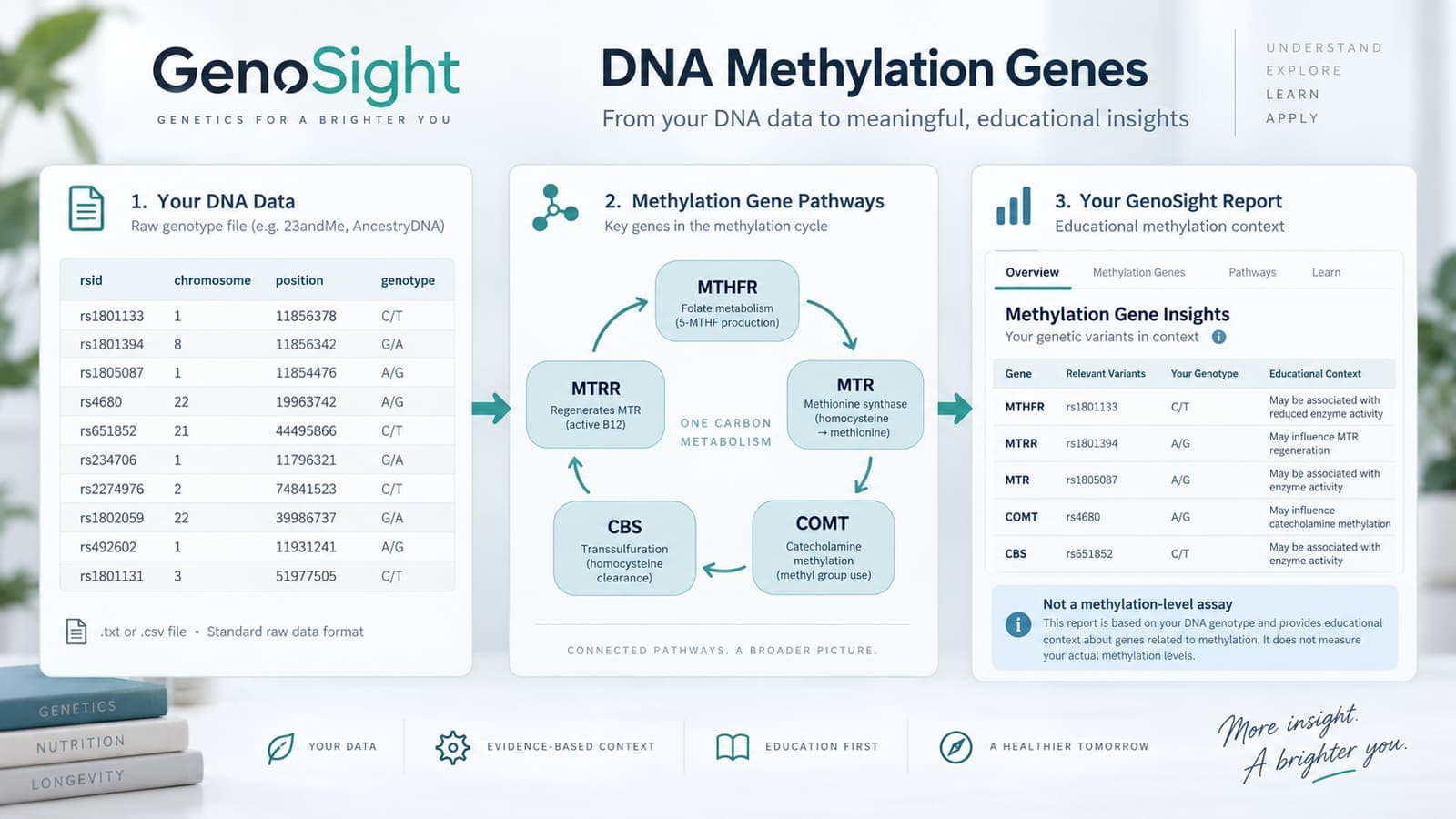
GenoSight organizes compatible consumer raw DNA findings into educational reports with source links and caveats. It does not diagnose conditions or prescribe treatment.
A practical takeaway
VDR is a real gene with an important role in vitamin D signaling. A common VDR marker in a consumer raw DNA file is not the same as a rare pathogenic VDR variant, a vitamin D blood test, or a treatment plan. Keeping those distinctions clear makes a raw-DNA result more useful and less likely to be overread.
Sources checked November 10, 2026
- MedlinePlus Genetics: VDR gene.
- NCBI Gene: VDR vitamin D receptor.
- Malloy et al.: Vitamin D receptor mutations in patients with hereditary 1,25-dihydroxyvitamin D-resistant rickets.
- NIH Office of Dietary Supplements: Vitamin D fact sheet for health professionals.