polygenic risk
Polygenic Risk Score: How to Read a DNA Risk Estimate
Understand polygenic risk scores, percentiles, ancestry limits and raw DNA requirements, with a checklist for evaluating a report before acting on it.
GenoSight Team · October 8, 2026 · 6 min read
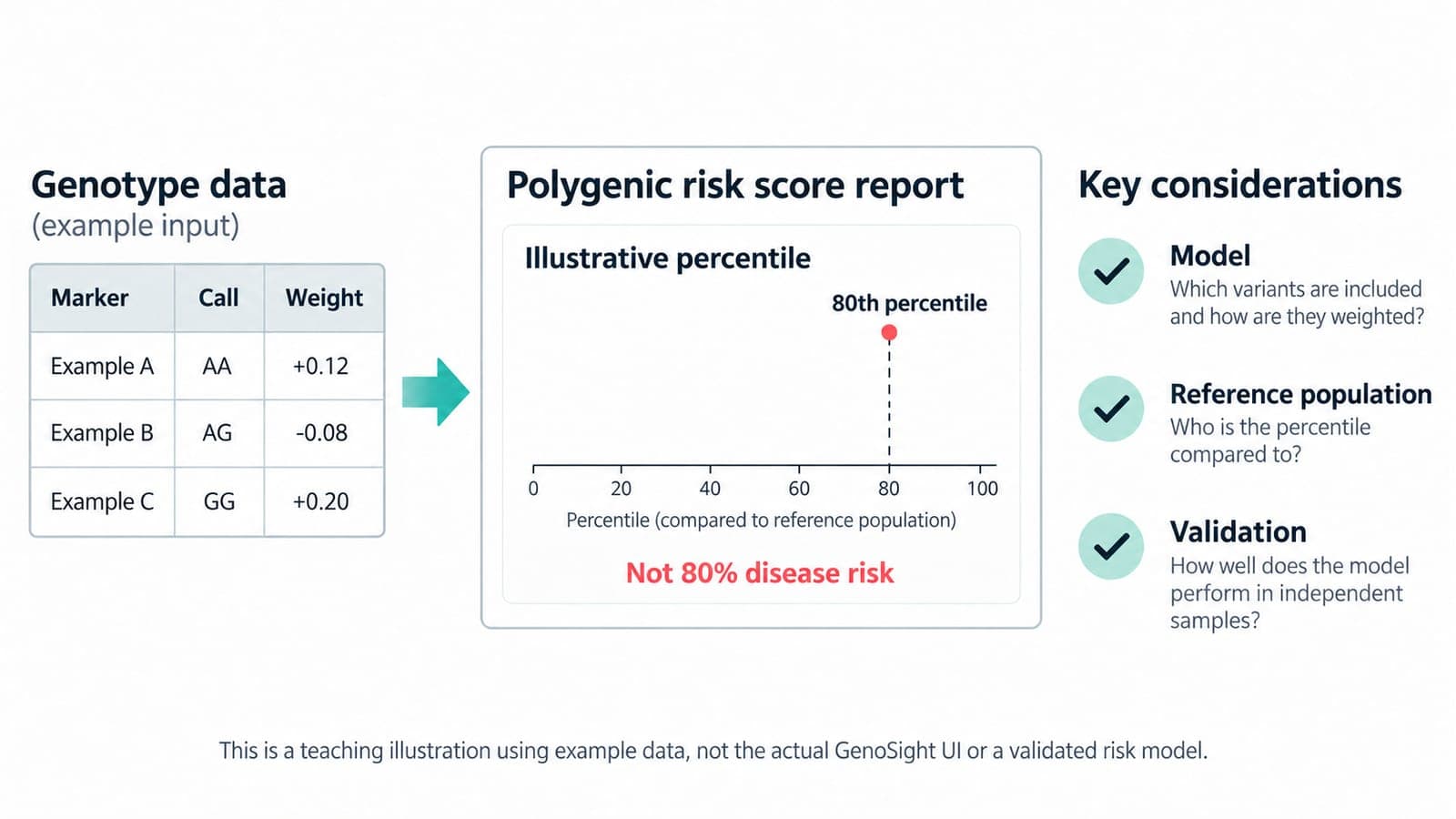
A polygenic risk score combines the estimated effects of many genetic variants into a measure of genetic predisposition to a particular trait or disease. A score percentile describes a position within a reference population, not the probability of developing disease. Reading a polygenic risk score responsibly requires the model, input quality, validation population and clinical context.
Evidence checked October 8, 2026. This guide explains how to evaluate a score; it does not calculate a personal score or establish that an educational GenoSight report is a validated clinical PRS.
What a polygenic risk score measures
Many common conditions involve numerous genetic variants alongside environmental and other influences. A PRS summarizes part of that genetic contribution. Researchers estimate variant effects from study data and combine those effects with an individual's genotype profile. The Choi, Mak and O'Reilly methods tutorial describes this process and emphasizes quality control and careful interpretation.
The word polygenic means that many variants contribute. It does not mean that the score measures every cause of a condition. A genetic predisposition estimate also differs from a test that identifies a specific variant associated with a single-gene disorder. Neither label alone tells you which medical decision is appropriate.
A report should name the condition or trait being estimated. A generic heading such as "genetic health score" leaves an essential question unanswered: a score for what? Look for a model identifier or publication, the version used, and an explanation of the input data. These details make the result traceable rather than merely impressive-looking.
Percentile, relative risk and absolute risk
These three numbers answer different questions. Treating them as interchangeable can turn an informative report into an alarming one.
| Report term | Question it answers | What to ask next |
|---|---|---|
| Score percentile | Where does this score rank within the stated reference group? | Which population and model define that ranking? |
| Relative risk | How does estimated risk compare with the stated comparison group? | What is the comparison and how was the estimate validated? |
| Absolute risk | What probability is estimated over a defined period? | Which age, clinical factors, population and time horizon are included? |
In a fictional example, an 80th-percentile score ranks above roughly 80% of scores in the named reference group. It does not mean an 80% chance of disease. The graphic below uses example data only; its three marker rows are not a working model or a recipe for calculating a PRS.
The NHGRI explanation of polygenic risk scores distinguishes relative from absolute risk and explains why age and other context matter. A stand-alone genetic score does not supply a disease probability or a timeframe. If a provider reports absolute risk, read the additional model that translates genetic and clinical inputs into that estimate.
Why the model and population matter
There is no universal PRS that applies equally to every condition, population and setting. A model has a development dataset, a set of variants and weights, and evaluation results. Two models for the same trait can use different inputs and produce different outputs. A change in score therefore needs an explanation before it is treated as a change in health.
The original Polygenic Score Catalog publication describes a resource containing published score definitions, including variants, alleles, weights and metadata. It also separates score development from evaluation in external samples. A catalog identifier helps you find the underlying research, but inclusion in a research resource is not a personal medical recommendation.
Ask whether the model was evaluated in people relevant to the intended use. Ancestry, age, the condition definition and the clinical setting can affect interpretation. Evidence from one population should not be assumed to transfer unchanged to another. A provider should explain both the validation evidence and its limitations, rather than using an ancestry label as a blanket assurance.
Also separate prediction from usefulness. A model may distinguish groups statistically without establishing that a particular action improves an individual's outcome. Clinical decisions require evidence for the proposed use, not simply a colorful high-risk category.
Can a consumer raw DNA file support a score?
A successful file upload establishes that software accepted a file. It does not establish that every marker required by a score was measured, that the scoring pipeline handled missing data correctly, or that the result was validated for clinical use.
Our genotyping versus sequencing guide explains why consumer array exports contain selected marker calls. Before evaluating a PRS made from such a file, ask how the provider handles coverage, missing markers, reference builds and allele alignment. Our guides to GRCh37 versus GRCh38 and DNA strand orientation explain two sources of mismatches when genetic records are compared.
Imputed genotypes are statistically inferred rather than newly measured. If a pipeline uses imputation, its documentation should state that clearly and describe relevant quality checks. Missing information should not be silently interpreted as a negative result.
A 2026 empirical study of polygenic-score analytical validity found that missing-marker effects depend on the markers' weights for the trait and evaluated reproducibility across genotyping and processing approaches. The practical lesson is to ask about the complete scoring pipeline, not only the test brand printed on the original DNA file. That study does not validate every consumer upload service.
A checklist before acting on a report
Save the report version and review these details before interpreting its category:
- The exact target. Record the trait or condition, model identifier, version and source publication.
- The number's meaning. Identify whether the result is a raw score, percentile, relative risk or absolute risk, and preserve its comparison group and timeframe.
- The input method. Record the original test, file build, measured-marker coverage, missing-data handling and any imputation.
- The validation evidence. Look for independent evaluation, the populations studied and the limitations relevant to you.
- The intended decision. Ask what evidence supports using this result for the proposed clinical action, and what other information is required.
Keep genetic files private when asking for help. A focused question about the model and interpretation is usually a better starting point than posting an entire raw file or identifiable report publicly.
The FDA's direct-to-consumer testing guidance explains that evidence and variant coverage differ between tests and recommends discussing clinically relevant results with a qualified professional. A low genetic estimate does not rule out disease. A high estimate does not diagnose it. Do not change medication or screening solely because an uploaded-file report gives a high or low category.
For a GenoSight educational report, start by comparing the presentation with the sample report: look for the question being answered, cited evidence and stated limits. A clear explanation of an individual finding is useful, but it should not be mistaken for proof that a validated PRS was computed. Confirm the particular report's method before making that assumption.
Review how GenoSight presents DNA findings
Explore an educational sample report with cited findings and limitations before deciding whether to upload your raw DNA file.
Sources and verification
- Choi, Mak and O'Reilly: PRS analysis tutorial (2020): construction, quality control and interpretation. Checked October 8, 2026.
- NHGRI: Polygenic Risk Scores: relative and absolute risk. Checked October 8, 2026.
- Lambert and colleagues: the Polygenic Score Catalog (2021): score definitions and evaluation metadata. Checked October 8, 2026.
- Empirical evaluation of analytic validity of polygenic scores (2026): missing markers and pipeline reproducibility. Checked October 8, 2026.
- FDA: Direct-to-Consumer Tests: evidence, coverage and clinical follow-up. Checked October 8, 2026.