snps explained
Haplotype vs Genotype: What a Raw DNA File Shows
Learn how a genotype differs from a haplotype, what consumer raw DNA files usually show, and why phase matters before interpreting linked variants.
Sebastian Thorp · November 6, 2026 · 4 min read
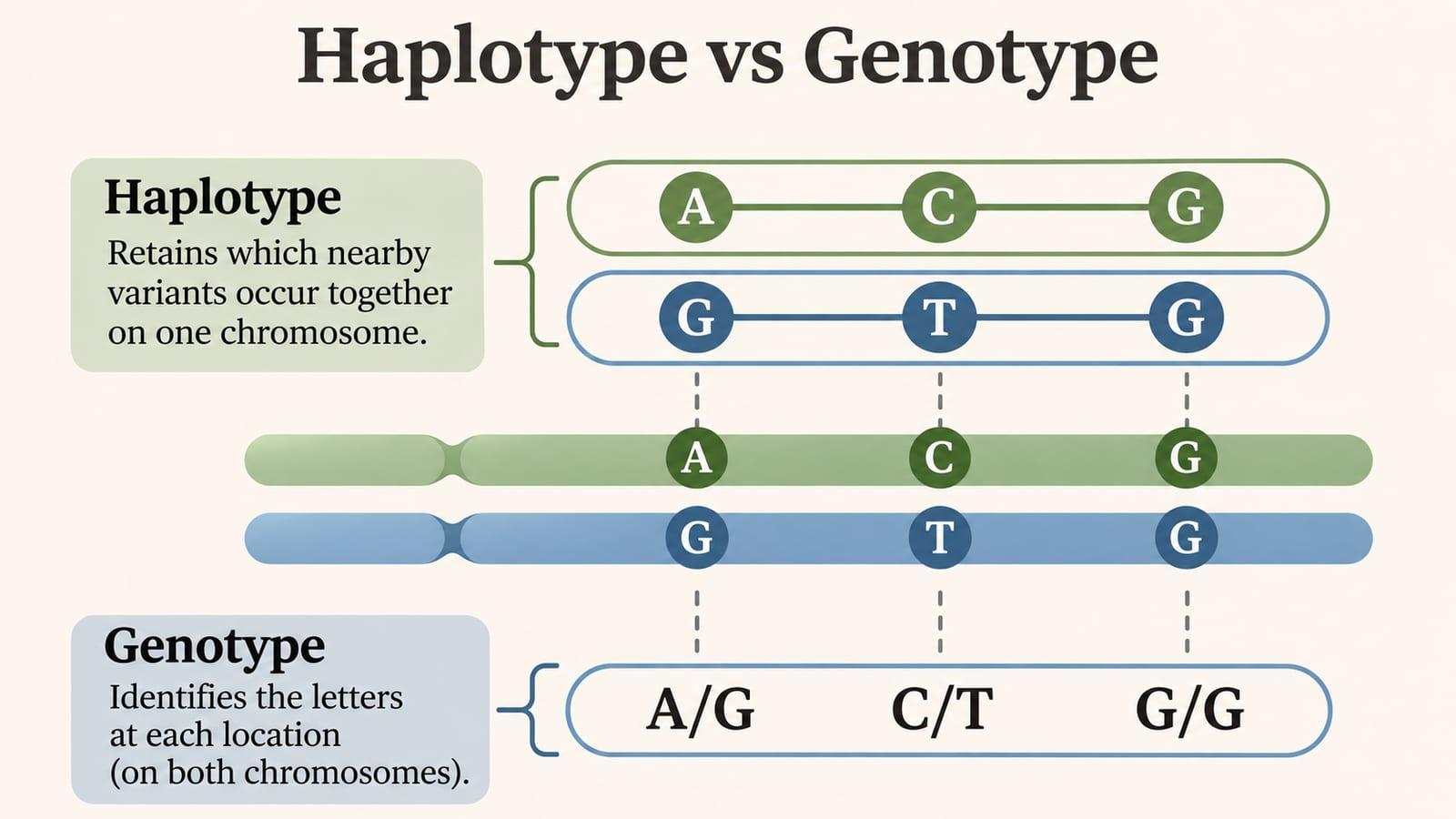
A genotype is the DNA result reported at one location, such as A/G at a SNP. A haplotype is the combination of nearby variants that occur together on one chromosome copy. A typical consumer raw DNA file is useful for reading genotype calls, but it often does not establish which neighboring variants came from the same parent.
That distinction matters when a report, paper, or clinician uses the word haplotype. It does not mean that every group of letters in a raw file is already a phased haplotype, and it does not turn a genotype call into a diagnosis.
The short version: location versus arrangement
The National Human Genome Research Institute defines a genotype as the variant information at a genomic location. For a simple biallelic marker, a raw DNA row might show C/T: one observed C allele and one observed T allele at that position.
A haplotype spans more than one nearby position. It describes the alleles that sit together along one physical chromosome and therefore tend to be inherited together. The same person has two chromosome copies in most autosomal regions, so there can be two haplotypes across that region.
| Question | Genotype | Haplotype |
|---|---|---|
| What does it describe? | The alleles observed at a location or set of locations | A linked set of alleles on one chromosome copy |
| Example | A/G at one SNP | A-C-G together on one chromosome segment |
| Does a basic raw file usually show it directly? | Usually, for markers the array measured | Not always; phase may be unknown or estimated |
| Why can it matter? | It tells you the reported call at a marker | It can show whether nearby variants are inherited together |
Why a raw file can have genotypes without phase
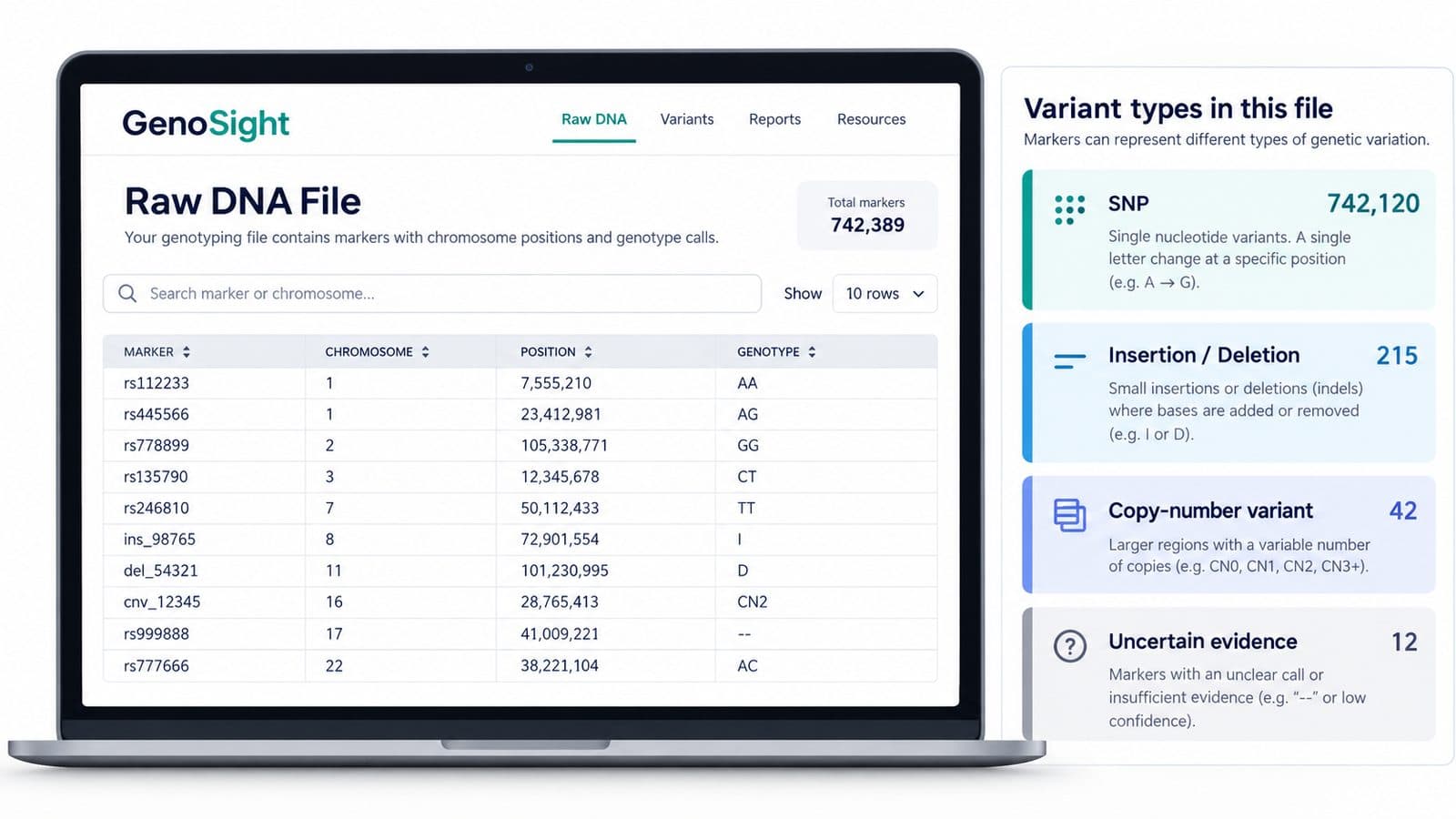
Consumer genotyping arrays report selected markers. At each measured marker, the file can often show the two alleles, but the file may not identify which allele belongs to which parental chromosome across several markers. That missing arrangement is called phase.
For example, imagine two neighboring positions with calls A/G and C/T. The raw calls alone are compatible with more than one arrangement: one chromosome could carry A with C and the other G with T, or the pairings could be A with T and G with C. A phased result resolves that arrangement; an unphased genotype table generally does not.
Researchers can infer or measure phase with family data, specialized laboratory methods, long reads, or statistical reference panels. The International HapMap Project overview explains why linked SNP patterns and tag SNPs are useful in population research. Inferred phase is still an estimate unless the method and evidence for that person are clear.
What this means for consumer DNA interpretation
Start by checking the basics: the marker ID, genome build, allele letters, provider coverage, and whether the result is a direct call or an imputation. The guide to rsID meaning explains why a marker label and its genotype are separate pieces of information; DNA strand orientation covers another reason allele letters can appear to disagree across sources.
Then ask whether the claim actually requires a haplotype. Some everyday educational questions only need a measured genotype. Other questions, including some medication-response and recessive-disease interpretations, can depend on variants being on the same or opposite chromosome copies. Those questions require method-specific, often clinical, context. The reference-pangenome review describes how haplotypic information and phasing can matter for some genomic applications.
Do not reconstruct a personal haplotype by guessing from a few raw DNA rows. A consumer file is not a substitute for a clinically validated test, a family-based phase analysis, or professional interpretation when a health decision depends on the result.
A practical way to read the terms
Use this sequence when an article or report mentions both words:
- Read the genotype first. Confirm the exact marker and reported allele pair.
- Check whether phase is stated. Look for wording such as phased, inferred, imputed, family-based, or long-read.
- Separate association from personal meaning. A haplotype can be relevant to a research association without predicting an outcome for one person.
- Escalate the right question. If a result could affect medication, reproductive, or disease decisions, discuss clinical confirmation with a qualified healthcare professional.
GenoSight can organize compatible 23andMe, AncestryDNA, and MyHeritage raw-file findings into educational report context. GenoSight does not claim that an unphased consumer file establishes a clinical haplotype or replaces diagnostic testing.
See what your raw DNA file can support
Start with a compatible raw genotype file and review marker-level findings with citations, caveats, and clear limits.
Sources checked November 6, 2026
- National Human Genome Research Institute: Genotype and Haplotype.
- National Human Genome Research Institute: About the International HapMap Project.
- NCBI/PMC: A strategy for building and using a human reference pangenome.