clinical genetics
Genetic Penetrance: What a DNA Variant Can Mean
Learn what genetic penetrance means, why a variant may not lead to a trait, and how to review raw DNA findings without overreading them.
GenoSight Team · October 10, 2026 · 5 min read
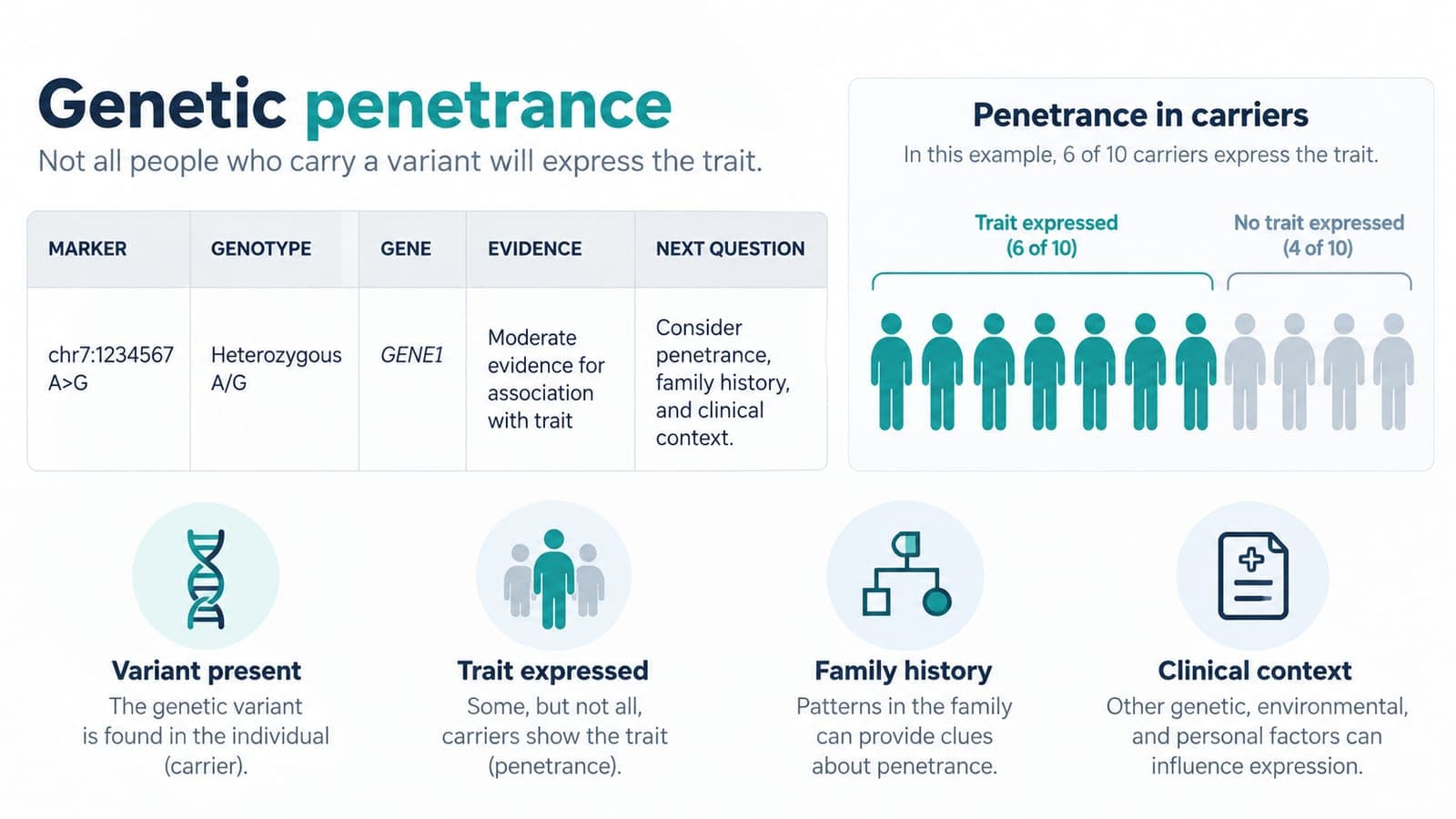
Genetic penetrance describes how often people with a particular genotype or variant show the associated trait or condition. A raw DNA file can sometimes show that a marker was reported, but it usually cannot tell you penetrance by itself. To interpret a result responsibly, keep the variant, condition, evidence source, family history and clinical context separate.
Evidence checked October 10, 2026. This guide is educational and does not diagnose disease, estimate a personal risk percentage, or replace clinical genetic counseling.
What genetic penetrance means
Penetrance answers a yes-or-no population question: among people who carry a particular genotype or variant, what proportion show the associated trait or condition? MedlinePlus Genetics explains reduced penetrance as a situation where some people with a variant do not develop features of the disorder. The NCI genetics dictionary uses the same practical framing: incomplete penetrance means some people with a pathogenic variant express the associated trait while others do not.
That matters because a variant label is not the same thing as a prediction for one person. A report may say that a variant is associated with a condition, but penetrance asks how reliably that association becomes visible in real people. The answer can depend on the exact variant, age, sex, other genetic factors, environment, ascertainment method and the way the condition is defined.
Reduced penetrance versus variable expressivity
Reduced penetrance and variable expressivity are related, but they answer different questions.
| Concept | Question it answers | Raw DNA reading mistake to avoid |
|---|---|---|
| Penetrance | Do people with this genotype show the trait at all? | Treating a variant as a guaranteed outcome |
| Reduced penetrance | Do only some carriers show the trait? | Treating an unaffected carrier as impossible |
| Variable expressivity | How do features differ among affected people? | Assuming everyone with the variant has the same severity |
MedlinePlus separates these concepts clearly: penetrance concerns the proportion of people who show signs and symptoms, while expressivity concerns the range of signs and symptoms among affected people. A PubMed-indexed review on penetrance and expressivity describes modifier genes, sex and environmental factors among mechanisms that can influence these patterns.
For raw DNA users, the key move is simple: do not turn "variant present" into "condition certain." Also do not turn "condition absent today" into "the variant is irrelevant." Penetrance is a population-level evidence concept, and it often needs clinical context before it can support an individual decision.
Why a raw DNA row is not a penetrance estimate
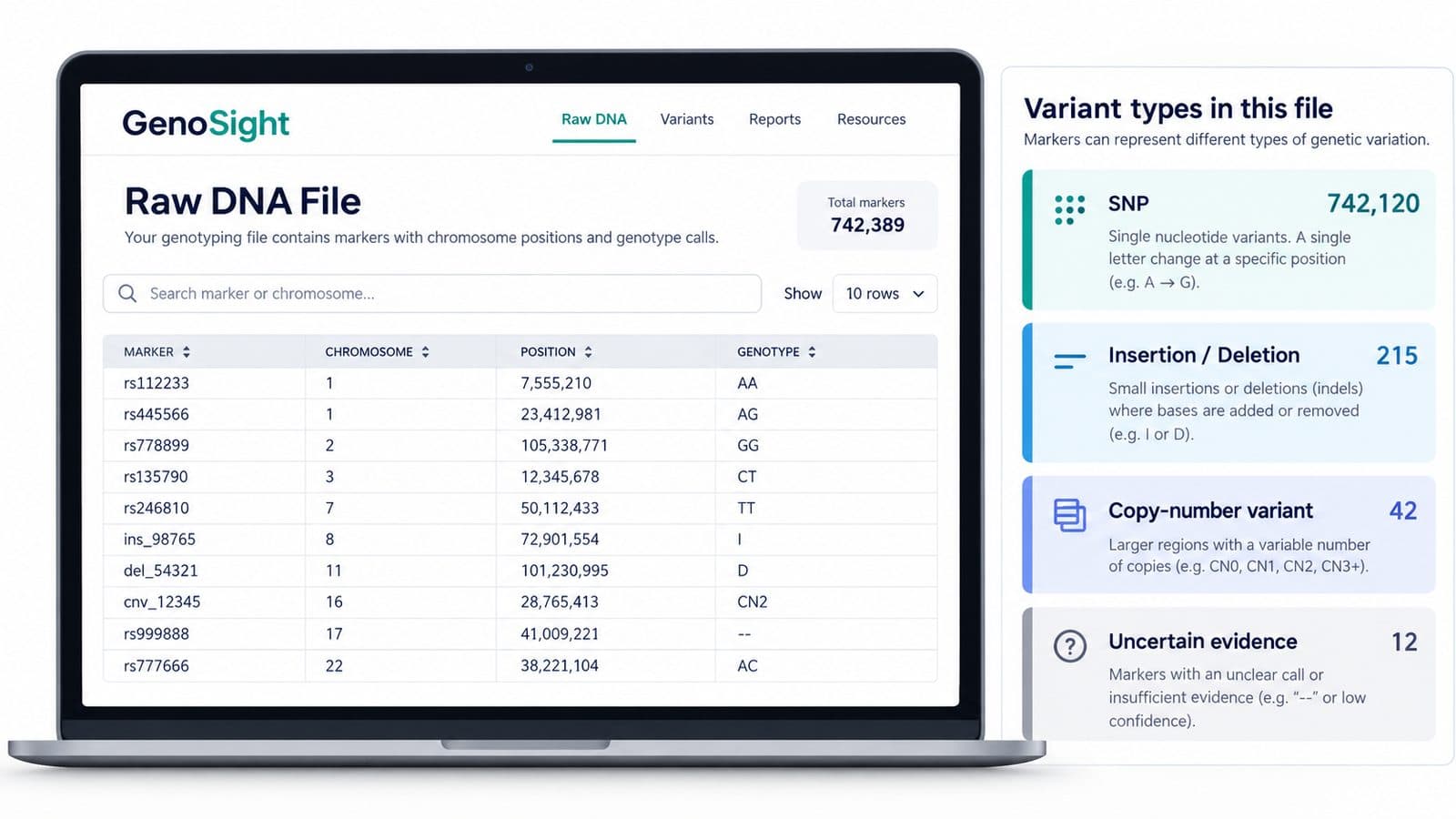
A consumer raw DNA file usually contains selected marker calls. It may list a marker, chromosome, position and genotype. That is useful information, but it is still only the starting layer.
| Layer | What it can tell you | What it cannot tell you alone |
|---|---|---|
| Marker row | Which location or assay result was reported | Whether the finding is clinically meaningful |
| Genotype | Which alleles were called at that marker | Whether a condition will appear |
| Variant evidence | What studies or databases say about a variant | Whether the evidence fits your full situation |
| Penetrance estimate | How often carriers express a trait in a defined setting | Your diagnosis, treatment plan or screening schedule |
Our genetic variants guide explains why marker, genotype, variant type and clinical interpretation are separate layers. Our genotyping versus sequencing guide explains why a consumer array file is not a complete genome sequence. A missing marker, no-call value or successful upload does not prove that a penetrance estimate is available.
Penetrance is especially easy to overread when a database page uses clinical terminology. A variant may be classified in a particular gene-disease context, but that classification still needs the exact variant, condition, inheritance pattern, population frequency, review status and clinical history. ClinGen variant classification guidance points users back to ACMG/AMP-style evidence criteria and warns that its information is not intended for direct diagnostic use without genetics professional review.
A safer review workflow
Use this sequence before acting on a penetrance claim from a raw DNA search:
- Save the original row. Keep marker ID, genotype, chromosome, position, provider, file date and reference build together.
- Name the exact claim. Is the source defining penetrance, reporting a disease association, classifying a variant, or recommending clinical action?
- Check the variant-condition pair. Penetrance belongs to a specific variant or genotype in relation to a specific trait or condition.
- Look for the population and method. Family-based studies, clinical cohorts and population cohorts can produce different-looking estimates.
- Separate penetrance from expressivity. First ask whether carriers show the trait at all; then ask how features vary among affected people.
- Use clinical follow-up for clinical decisions. Do not change medication, screening, pregnancy care or supplements from a raw-file row alone.
The NCBI Bookshelf evidence framework for genetic testing notes that reduced penetrance makes genetic information harder to use for risk prediction. That is not a reason to ignore genetics. It is a reason to keep the evidence trail visible instead of compressing it into a simple yes-or-no result.
How GenoSight frames penetrance in reports
GenoSight's educational reports start from the file you upload, then organize the finding around what the file can and cannot support. A penetrance-aware explanation should preserve the original genotype context, cite the evidence source, name the relevant condition or trait, and state when clinical confirmation or genetic counseling is the appropriate next step.
That framing is different from a raw database lookup. A lookup can be useful when it helps you identify a marker or source, but it may not explain whether the evidence applies to a consumer raw file, whether the file measured the right variant directly, or whether the finding has enough clinical support for action.
If you are comparing a result with family history, keep identifiable genetic files private. A focused question about the variant, condition, source and next step is usually safer than posting a full raw DNA file or personal report publicly.
Review DNA findings with context
GenoSight turns compatible raw DNA files into educational reports that keep genotype calls, evidence, limitations and follow-up questions separate.
The practical takeaway
Penetrance helps explain why a genetic variant can matter without guaranteeing the same outcome for every carrier. Reduced penetrance means some people with a variant show the associated trait or condition and others do not. A raw DNA file can support careful evidence review, but it should not be treated as a stand-alone penetrance calculator.
The most useful next step is to preserve context. Keep the original marker row, identify the exact variant-condition claim, check the evidence source, and use clinical guidance when the result could affect medical care.
Sources
- MedlinePlus Genetics - What are reduced penetrance and variable expressivity?, accessed October 10, 2026.
- National Cancer Institute - Reduced penetrance, accessed October 10, 2026.
- Zlotogora - Penetrance and expressivity in the molecular age, accessed October 10, 2026.
- NCBI Bookshelf - Understanding Genetic Variance and Phenotype Expression, accessed October 10, 2026.
- ClinGen - Variant Classification Guidance, accessed October 10, 2026.