snps explained
GenoSight vs Promethease vs SelfDecode vs Nebula 2026
Compare GenoSight, Promethease, SelfDecode, and Nebula on raw DNA upload support, price, AI synthesis, citations, privacy, and clinician-ready reports.
Sebastian · May 1, 2026 · 9 min read
In short
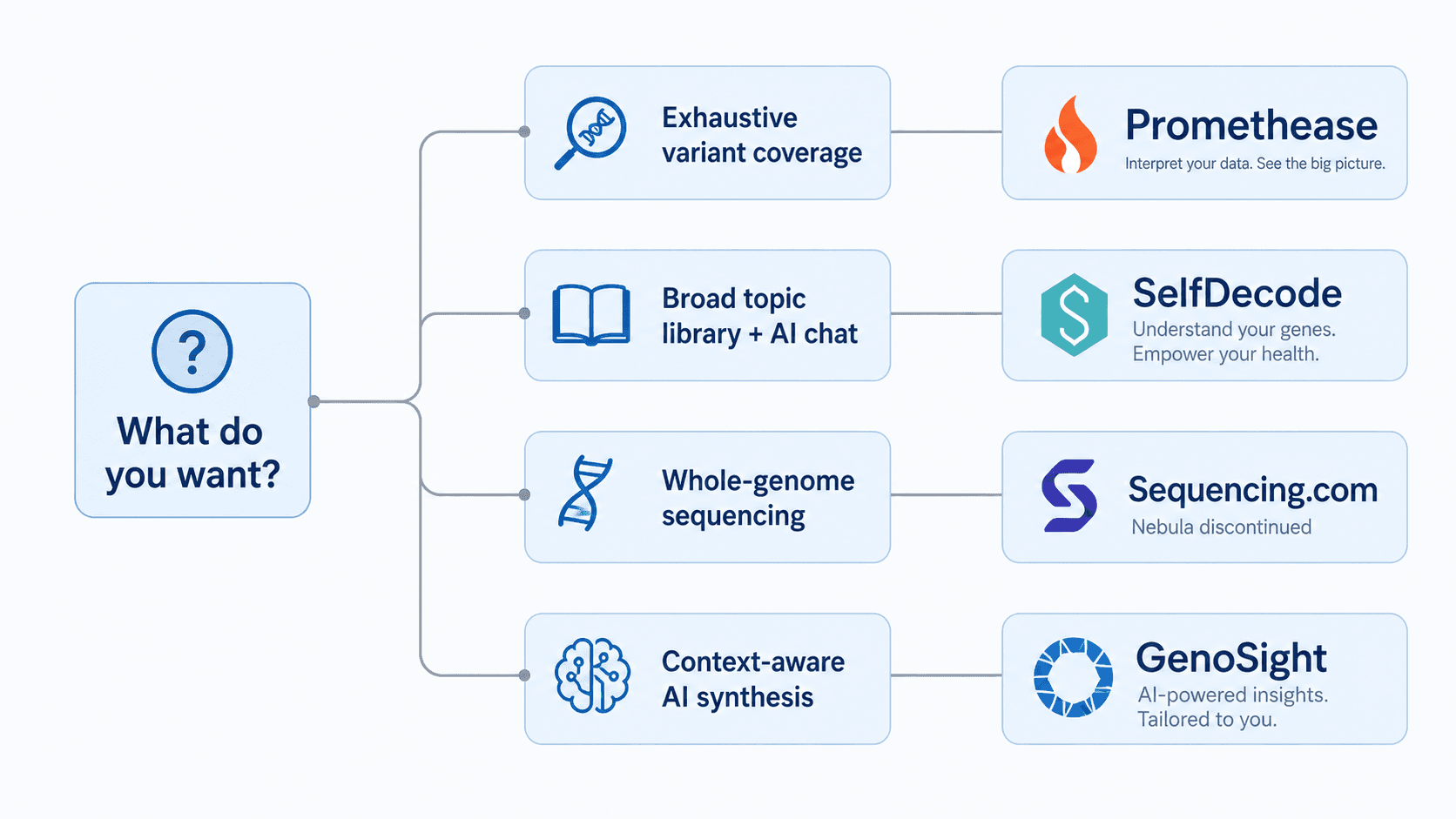
Promethease is not free: Promethease says most reports cost $25, and additional data files in the same report cost $4 per file. GenoSight is best for people who want to try an educational raw DNA report before paying, Promethease is best for people who want a paid SNPedia-style variant lookup, SelfDecode is best for a broader health platform, and DNA Complete by Nebula is best for buying whole-genome sequencing. This guide compares GenoSight, Promethease, SelfDecode, and Nebula/DNA Complete on file support, price, AI synthesis, evidence transparency, privacy posture, and practical next steps.
The four options, briefly
Promethease is the long-running variant lookup tool connected to SNPedia. You upload a raw genotype file and receive a large report that maps your variants to SNPedia entries. The strength is breadth. The weakness is prioritization: you still need to decide which findings are important, current, and worth discussing with a healthcare professional. Checked August 28, 2026: Promethease says most reports cost $25, with additional files at $4.
SelfDecode is a broad consumer health platform with DNA upload, lab tracking, topic reports, recommendations, and an AI health interface. It is closer to a health-membership product than a single report. SelfDecode's own pricing page says raw DNA upload can start free, while full access combines a subscription, DNA analysis payment, and optional add-ons such as pharmacogenomics or carrier status reports (SelfDecode pricing).
Nebula / DNA Complete is now best understood as a whole-genome sequencing path rather than a raw DNA upload interpretation tool. The current Nebula and DNA Complete sites present DNA Complete by Nebula Genomics as a WGS product that analyzes essentially the full genome rather than the less-than-one-percent slice covered by consumer genotyping arrays (Nebula, DNA Complete). That is a different buying decision from re-analyzing a file you already paid for.
GenoSight reads your existing raw file from 23andMe, AncestryDNA, or MyHeritage, runs curated analysis engines, and synthesizes findings against a six-domain personal profile. The output is designed for practical use: an educational report, citations, a clinician-handoff PDF, and follow-up chat grounded in your actual findings.
Quick comparison
| Question | Promethease | SelfDecode | Nebula / DNA Complete | GenoSight |
|---|---|---|---|---|
| Best fit | Exhaustive variant lookup | Broad health platform | New WGS test | Context-aware raw DNA report |
| Uses your existing 23andMe / AncestryDNA / MyHeritage file | Yes | Yes | Upload paths may vary; core offer is WGS | Yes |
| Requires buying a new DNA test | No | Optional | Usually yes for WGS | No |
| AI synthesis | No | Yes | Product-dependent | Yes |
| Findings-grounded chat | No | Yes | Product-dependent | Yes |
| Personal profile context | No | Partial / platform-dependent | Product-dependent | Yes, six domains |
| Clinician-ready PDF | No | Limited | Product-dependent | Yes |
| Main pricing model | Per report | Subscription + analysis + add-ons | WGS kit / membership | Free trial, subscription, or lifetime |
| Main risk | Information overload | Complex pricing and scope | Higher cost and turnaround | Educational scope, not diagnostic |
Which one should you choose?
Best for: lowest-cost paid variant lookup. Choose Promethease if you want a deep SNPedia-style lookup and you are comfortable doing your own triage. Honest limitation: the report can be broad and noisy, so you still need to decide which findings are current, important, and worth discussing with a clinician.
Best for: broad ongoing health-platform workflows. Choose SelfDecode if you want DNA reports, labs, recommendations, and ongoing health features in one product. Honest limitation: the real cost can include a subscription, DNA analysis, and optional add-ons rather than one simple raw-file report.
Best for: buying new whole-genome sequencing. Choose DNA Complete by Nebula if your main goal is WGS coverage rather than reusing a consumer genotype file. Honest limitation: WGS is a bigger purchase and does not automatically mean clearer interpretation.
Best for: trying a cited educational report from an existing raw file. Choose GenoSight if you want the file you already have turned into a readable, profile-aware report. Honest limitation: GenoSight is educational and array-based, so it is not a diagnostic test or clinical genetic confirmation.
Choose Promethease if you want the cheapest deep lookup and you are comfortable doing your own triage. It is useful for people who enjoy reading variant-level annotations and following references. It is less useful if you want a concise answer to "what should I pay attention to first?"
Choose SelfDecode if you want a full health platform around DNA, labs, recommendations, and ongoing content. The upside is breadth. The trade-off is that the real cost is not just "upload my file"; it can include membership, one-time DNA analysis, and optional report categories. That may be fine if you want the whole platform, but it is less clean if you only want a focused report from an existing raw file.
Choose Nebula / DNA Complete if your main goal is whole-genome sequencing. WGS can capture far more positions than a consumer genotyping array, including many variants that array-based services will never see. It also costs more, takes longer, and creates a much larger data-management question. If you already have a 23andMe, AncestryDNA, or MyHeritage file and want a fast second look, WGS is usually not the first step.
Choose GenoSight if you want the file you already have turned into a readable, cited, profile-aware report. GenoSight is built for people who do not want a 200-page variant dump. It explains what was found, why it may matter, how strong the evidence is, and what belongs in a conversation with a clinician. The six-domain profile is the practical difference: the same variant can be framed differently depending on your symptoms, goals, supplement context, habits, allergies, and demographics.
Price comparison for raw DNA shoppers
Prices change often, so confirm on each provider's site before purchasing. Checked August 28, 2026:
| Buyer question | Promethease | SelfDecode | Nebula / DNA Complete | GenoSight |
|---|---|---|---|---|
| Lowest useful entry point | $25 report; $4 per additional data file in the same report | Free upload to start; full platform requires paid access | WGS product pricing; DNA Complete shows Essential at $245 and Pro at $595 sale prices | $0 trial with 250 signup credits |
| Uses an existing raw DNA file without buying a new test | Yes | Yes | Not the primary use case | Yes |
| One focused report path | Yes | Not usually; platform model | No; WGS path | Yes |
| Ongoing chat | No | Yes | Product-dependent | Yes |
| Lifetime option | No | Not typical | Product-dependent | Yes, $229 |
| Best for budget-first users | Variant lookup | Only if free tier is enough | Usually no | Free trial, then choose plan if useful |
GenoSight's current tiers are:
| Plan | Price | What you get |
|---|---|---|
| Free trial | $0 | 250 signup credits, no card |
| Monthly | $11.99 / month | 1,500 credits per month for reports and chat |
| Yearly | $8.33 / month billed at $99.99 / year | 18,000 credits per year |
| Lifetime | $229 one-time | Weekly credit allowance with no subscription renewal |
Findings chat is 1 credit per message across paid plans.
Promethease is the clearest answer to the selected query: it is not free for most users. The current Promethease homepage says most reports cost $25, that reports are produced in under 10 minutes, and that additional data files in the same report cost $4 each. Larger data files can change runtime, so the practical total depends on how many files you upload and whether your file is unusually large.
Evidence and citations
This is where the services feel very different in practice.
Promethease surfaces a large number of SNPedia-backed variant annotations. That can be valuable, but the user has to separate old associations, weak associations, common benign variants, and clinically meaningful findings.
SelfDecode often presents findings as recommendations inside a larger health platform. That can be easier to read than a raw lookup, but shoppers should check whether the claim they care about links to primary evidence or to a broader educational article.
Nebula / DNA Complete emphasizes genome coverage. Coverage is not the same thing as interpretation quality. A WGS file can contain far more data than a consumer array, but the value depends on annotation quality, report clarity, update cadence, privacy controls, and whether clinically relevant findings are confirmed in a clinical setting.
GenoSight's product bet is narrower: make the evidence trail visible and keep the conclusion appropriately cautious. The report draws from sources such as ClinVar, PharmGKB, GWAS Catalog, and PubMed, then states findings as educational associations rather than diagnoses. See where GenoSight insights come from for the source model.
Privacy and data-retention questions to ask
Any genetic-data service should make these answers easy to find:
- What gets uploaded? Raw genotype file, WGS file, lab data, health profile, or all of the above?
- What gets stored? Raw file, parsed variants, derived findings, chat history, payment metadata, and reports may have different retention rules.
- What goes to AI providers? Some tools send raw data; others send only derived findings or limited context.
- Can you delete your account and data? Look for a specific deletion path rather than vague privacy language.
- Is your data sold, shared for research, or used for model training? Opt-in and opt-out details matter.
GenoSight's public privacy explainer is here: raw DNA data privacy after upload. The short version: the product is designed around converting the raw file into structured findings, limiting what crosses the AI boundary, and giving users an account deletion path.
The practical decision tree
If you mainly want the cheapest possible annotation of a raw file, start with Promethease and expect to do your own reading.
If you want a broad health dashboard with DNA, labs, recommendations, and many topic modules, compare SelfDecode's full plan and add-on costs against what you will actually use.
If you want deeper sequencing data because your question cannot be answered from an array file, compare WGS providers such as DNA Complete and Sequencing.com. Sequencing.com notes that U.S. WGS providers often range from $999 down to about $399, depending on provider and offer.
If you already have a consumer raw DNA file and want a concise educational report with citations, profile context, and follow-up chat, GenoSight is the direct path. For file compatibility, see DNA tests that allow raw data re-analysis. For the limits of any array-based analysis, read what consumer DNA tests cannot tell you.
Try GenoSight free
Upload your raw 23andMe, AncestryDNA, or MyHeritage file. 250 signup credits with no card.
Medical disclaimer
GenoSight provides educational information about your genetic data. It is not a medical diagnosis, treatment, or cure. Always consult your healthcare provider before making decisions based on this information. Variant interpretation evolves; recheck periodically.
Key takeaways
- Promethease is the simplest low-cost variant lookup; it is powerful but requires self-triage.
- SelfDecode is a broader health platform; compare the full plan, DNA analysis, and add-on costs before assuming it is a simple upload tool.
- Nebula / DNA Complete is best evaluated as a whole-genome sequencing purchase, not as a direct alternative to re-analyzing an existing 23andMe, AncestryDNA, or MyHeritage file.
- GenoSight is strongest when you already have a raw DNA file and want a cited, context-aware educational report with follow-up chat.
- None of these services replaces clinical genetic testing, diagnosis, or a clinician's interpretation when a finding could affect medical care.