methylation
CpG DNA Methylation and Raw DNA Files Explained
Learn what CpG DNA methylation means, how it differs from inherited genotype data, and why consumer raw DNA files need separate context.
GenoSight Team · October 6, 2026 · 5 min read
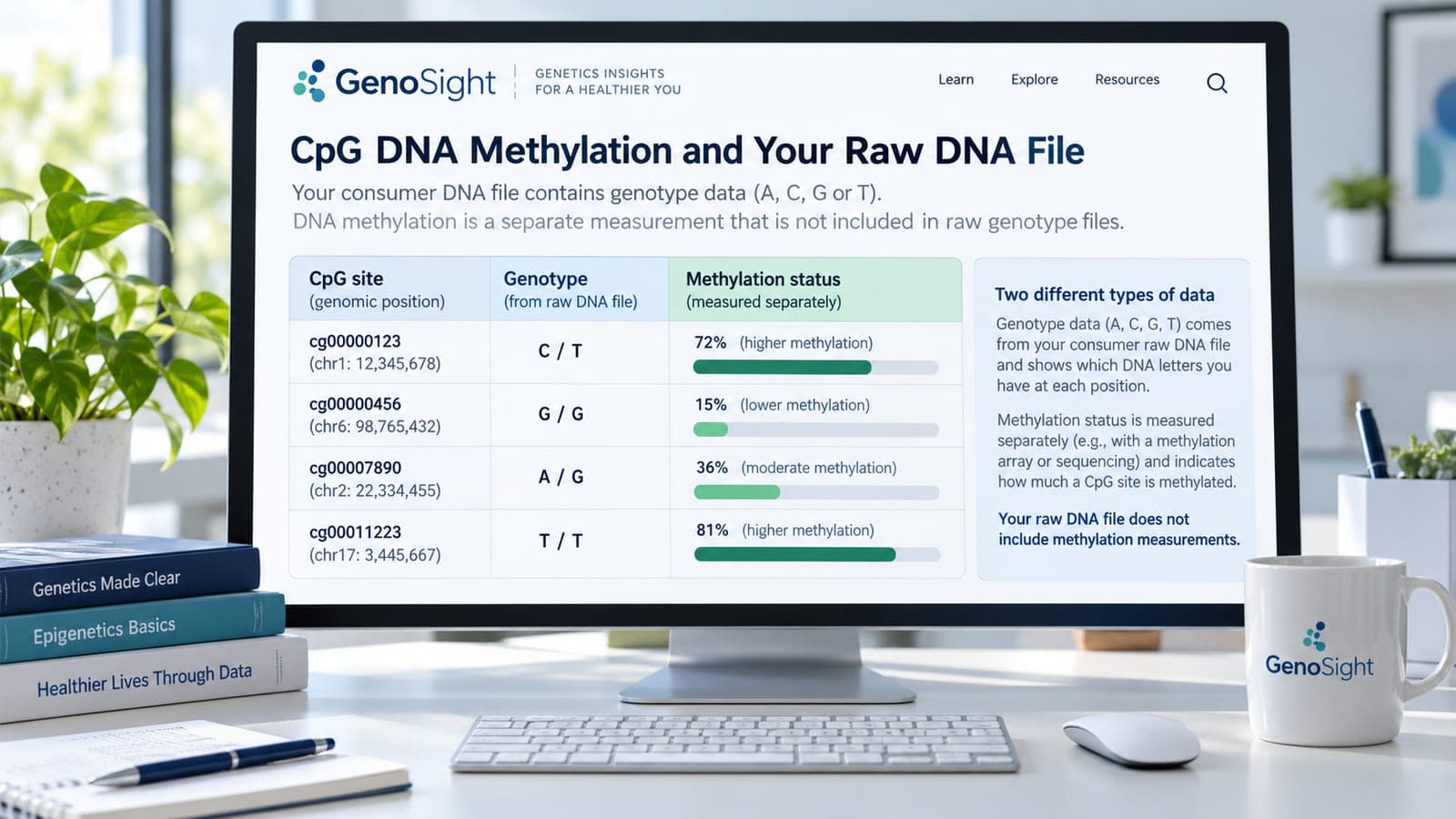
CpG DNA methylation is an epigenetic chemical mark measured at specific cytosine-guanine sites in DNA. A consumer raw DNA file usually reports inherited genotype letters, not CpG methylation percentages. GenoSight can help explain inherited raw-DNA context, but it does not measure your current CpG methylation status.
That boundary is the safest way to read methylation claims online. A raw file can show whether a provider measured selected inherited markers near genes such as MTHFR or COMT. It cannot show whether a CpG site in a sampled tissue is currently methylated, unmethylated, or changing over time.
What CpG means
CpG means a cytosine base followed by a guanine base in the DNA sequence. The "p" refers to the phosphate backbone between them. CpG sites are common targets for DNA methylation research because methyl groups can attach to cytosine at those positions.
The NHGRI glossary describes DNA methylation as a chemical tagging process that can affect gene expression. A review in Neuropsychopharmacology explains that DNA methylation often occurs at cytosines in CpG dinucleotides and that its biological meaning depends on genomic context, cell type, and nearby regulatory elements (Moore, Le and Fan, 2013).
CpG islands are CpG-rich regions, often found near gene promoters. A review on CpG islands and transcription notes that many promoter-associated CpG islands are usually unmethylated, while methylation in certain regulatory contexts can contribute to gene silencing (Deaton and Bird, 2011). More recent work reviews how CpG islands can affect gene regulation, development, imprinting, and disease research, but the result still has to be interpreted in its specific tissue and assay context (Blackledge and Klose, 2021).
Quick boundary
A genotype row such as A/G or C/T is inherited sequence data. A CpG methylation result is an epigenetic measurement, often reported as a percentage or beta value from a methylation-specific assay.
Why raw DNA files do not answer the CpG question
Most consumer raw DNA files are built from genotyping arrays or similar inherited-variant calls. They report letters at selected positions, often with an rsID, chromosome, position, and genotype. That is useful for inherited-variant interpretation, but it is not a methylation assay.
CpG methylation requires methods designed to preserve or infer methylation marks. For example, bisulfite-based workflows distinguish methylated from unmethylated cytosines because unmethylated cytosine is converted during treatment while methylated cytosine is more stable under that chemistry. A bisulfite-conversion protocol review explains that bisulfite analysis relies on unmethylated cytosines converting while methylated cytosines remain distinguishable after downstream analysis (Harrison and Parle-McDermott, 2011).
That method difference matters. If your file came from 23andMe, AncestryDNA, MyHeritage, or another consumer genotype provider, the file may support inherited-variant questions such as "Which genotype is reported at this marker?" It does not support direct statements such as "this CpG site is 72 percent methylated" unless a separate methylation test produced that measurement.
What GenoSight can and cannot tell you
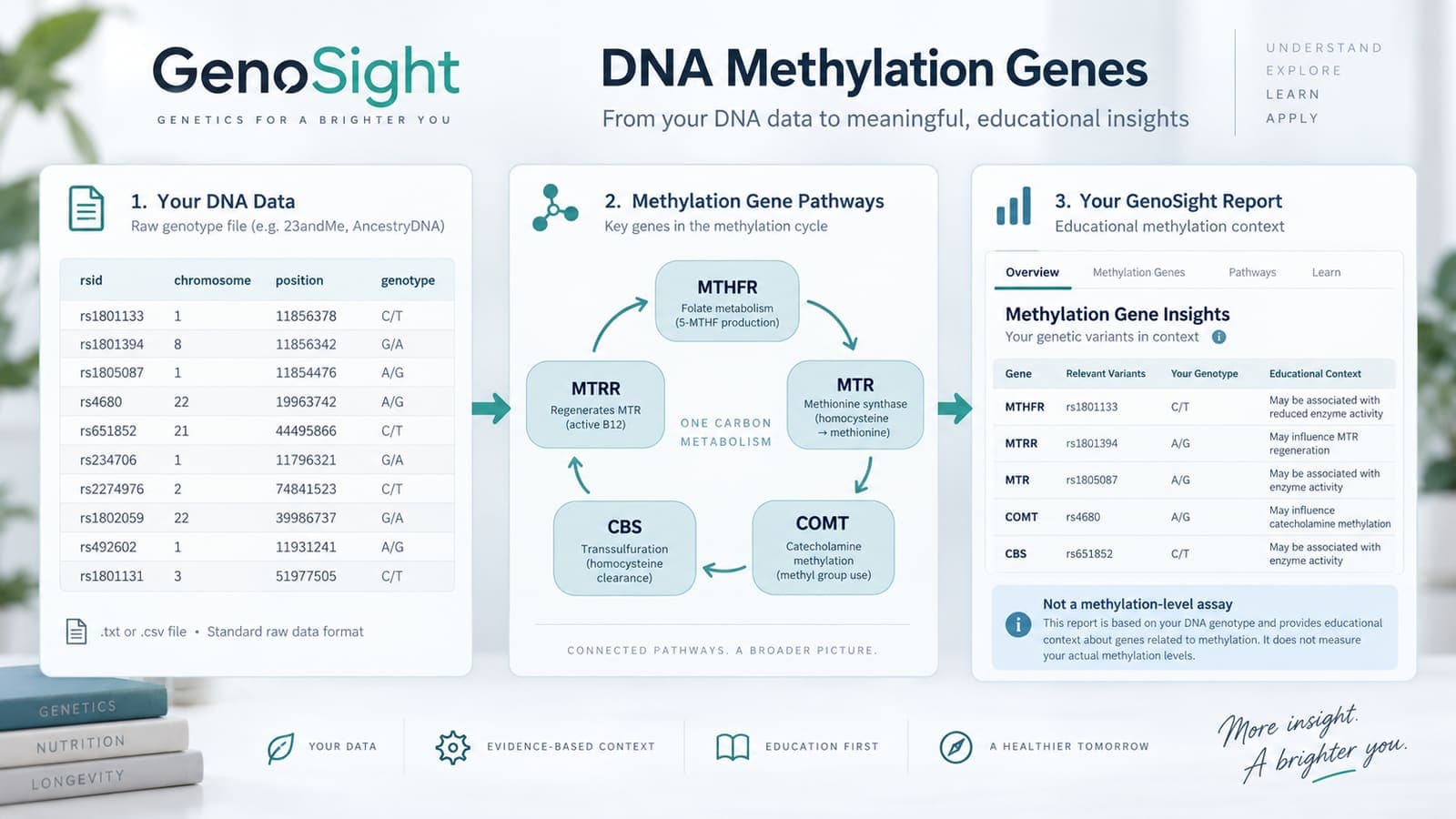
GenoSight is designed for people who already have a compatible raw DNA file and want a readable educational report. It can organize inherited markers, cite source context, and explain limitations. For methylation-related topics, that may include genes and pathways involved in folate metabolism, methyl donors, homocysteine handling, and catecholamine breakdown.
GenoSight does not measure CpG methylation, epigenetic age, tissue-specific methylation patterns, homocysteine, folate, B12, or metabolite levels. Those are different evidence types.
| Question | Data type needed | What a raw DNA file can contribute |
|---|---|---|
| Which inherited genotype is in my file? | Consumer raw DNA genotype call | Usually yes, if the marker is present and readable |
| Is this CpG site methylated in this tissue today? | Methylation assay, often array or sequencing based | No direct measurement |
| Does an inherited variant affect a methylation-related pathway? | Genotype plus source evidence and context | Sometimes, with cautious interpretation |
| Should I change a supplement, medication, or clinical plan? | Clinical history, labs, medication context, clinician review | Raw DNA may be background context only |
For adjacent reading, see DNA methylation genes and raw DNA files, MTHFR explained, and how to download raw DNA data.
How to read CpG methylation claims safely
Use a three-part check before acting on a CpG methylation claim.
First, ask what was measured. A genotype call, a CpG methylation percentage, a blood chemistry marker, and a gene-expression result are separate measurements. A source may discuss all four, but they should not be blended into one conclusion.
Second, ask where and when it was measured. DNA methylation can vary by tissue, development stage, cell mixture, environment, illness, and method. A claim from one cell type or study population may not transfer cleanly to a consumer raw DNA file.
Third, ask what decision the evidence supports. CpG methylation research can explain biology, but it does not automatically produce a personal supplement instruction or diagnosis. If a result connects to symptoms, pregnancy, medication response, cancer risk, neurological disease, or abnormal labs, bring the question to a qualified clinician.
A practical way to use this with a raw DNA report
Start by keeping the data categories separate:
- Inherited genotype: the letters in your raw DNA file.
- Epigenetic methylation: chemical marks measured by a methylation-specific test.
- Pathway chemistry: current lab values such as homocysteine, folate, B12, methylmalonic acid, or related markers.
- Clinical context: symptoms, medications, diagnoses, pregnancy status, family history, diet, and clinician interpretation.
Then use each tool for its proper job. A GenoSight report can help you see inherited context and organize questions. A methylation assay can measure methylation status in the sampled material. Blood or urine testing can show current chemistry. A clinician can decide what those pieces mean together.
Separate raw DNA context from methylation claims
Upload a compatible raw DNA file to see inherited methylation-pathway context with citations, caveats, and clear boundaries around what the file does not measure.
Sources
- NHGRI - Methylation, accessed October 5, 2026.
- Moore LD, Le T, Fan G. DNA methylation and its basic function. Neuropsychopharmacology. 2013.
- Deaton AM, Bird A. CpG islands and the regulation of transcription. Genes & Development. 2011.
- Blackledge NP, Klose RJ. Sequence determinants, function, and evolution of CpG islands. eLife. 2021.
- Harrison A, Parle-McDermott A. DNA methylation: bisulphite modification and analysis. Journal of Visualized Experiments. 2011. Accessed October 6, 2026.