population frequency
Allele Frequency: How Common a DNA Variant Is
Learn what allele frequency means in raw DNA reports, why population context matters, and how to avoid treating frequency as a personal diagnosis.
GenoSight Team · October 12, 2026 · 5 min read
Allele frequency is the proportion of one allele among all copies of that marker in a defined population. In a raw DNA report, allele frequency can help you tell whether a variant is common or rare in a reference dataset. It does not diagnose disease, estimate your personal risk, or prove that a marker is clinically meaningful.
Evidence checked October 12, 2026. This guide is educational and does not replace clinical genetic testing, medical advice, or genetic counseling.
What allele frequency means
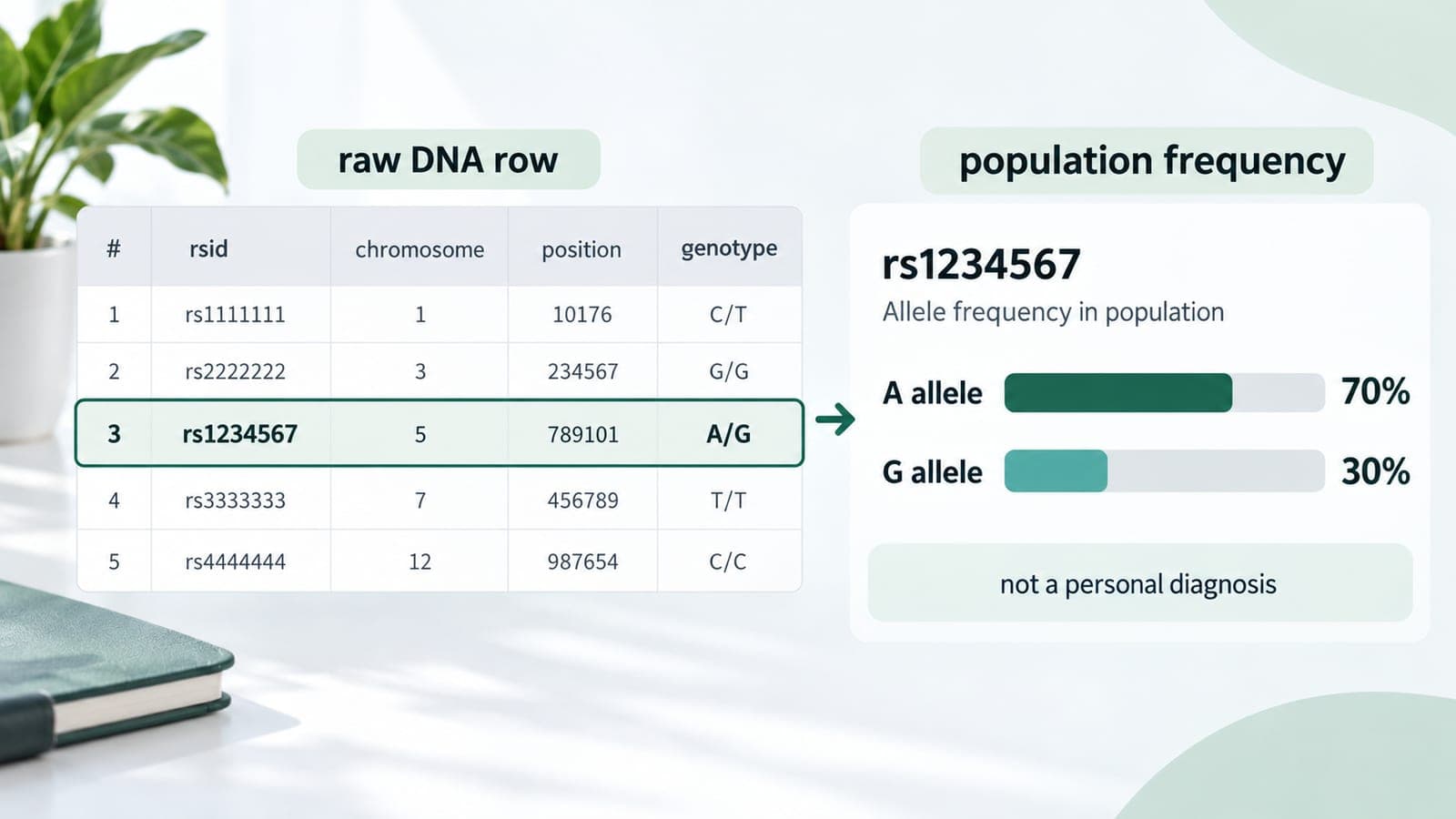
An allele is one version of a gene or DNA position. The NCBI Bookshelf glossary defines allele frequency as the proportion of a specific gene variant among all copies of the gene in the population. In a simplified example, if a population dataset contains 2,000 chromosome copies at a marker and 600 copies carry the G allele, the G allele frequency is 600 divided by 2,000, or 30%.
That population number is different from your genotype. Your raw DNA file may show a row such as rs1234567, chromosome, position and A/G. The frequency table asks a different question: how often does the A or G allele appear in a defined reference group?
The distinction matters because a common allele can look important when it appears in a search result, and a rare allele can look frightening when it appears near a disease name. Frequency is one evidence layer. It is not the whole interpretation.
Why raw DNA users should care
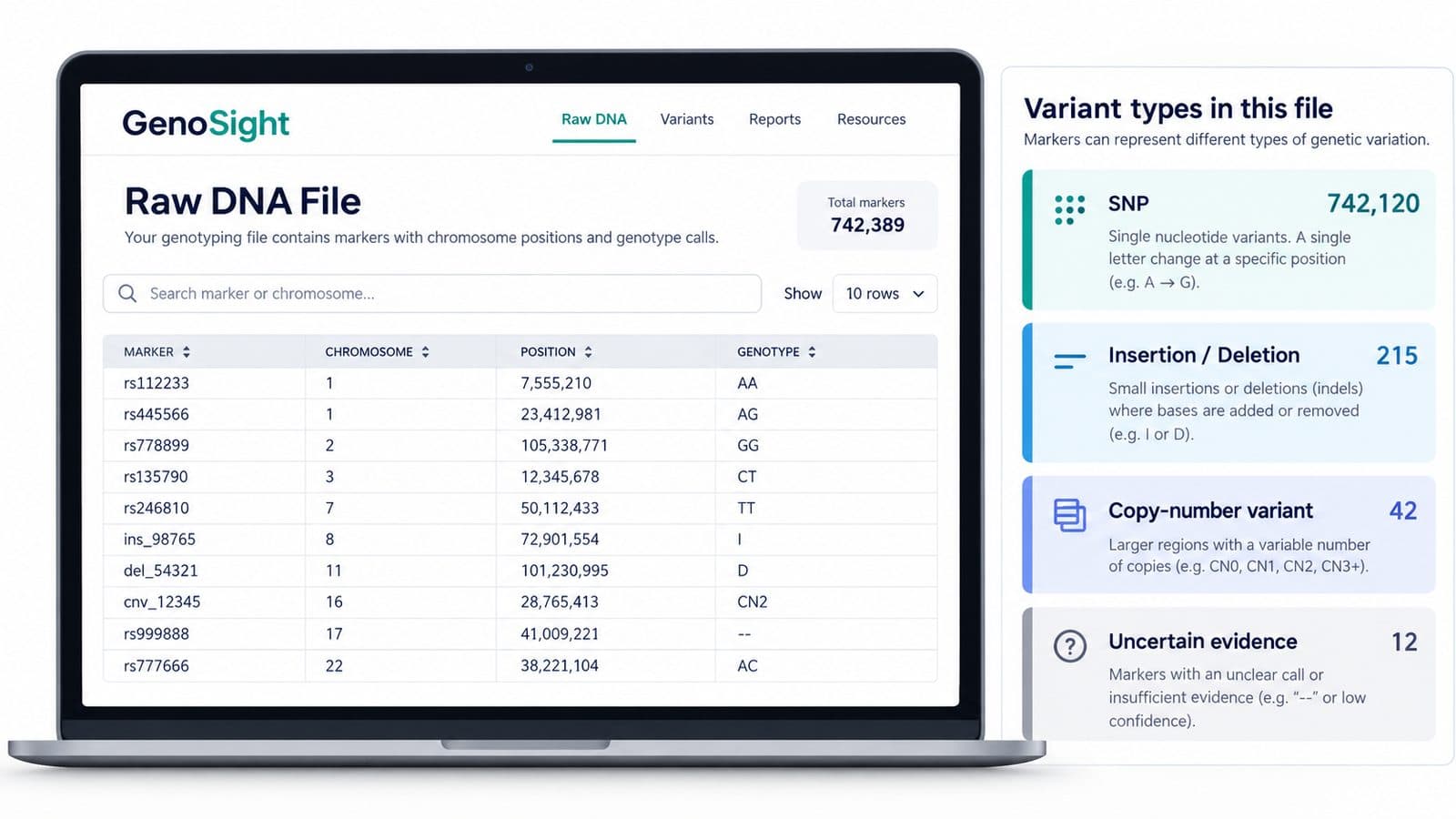
People often paste an rsID or genotype into a database and see labels such as "minor allele frequency," "global frequency," or "population frequency." Those labels are useful because consumer raw DNA files usually contain selected marker calls, not a full medical interpretation. Our rsID guide explains why the marker label and your genotype are separate pieces of information.
Frequency can help with three practical checks:
- Is the allele common or rare in the source being used? A variant seen often in a large reference population may be less plausible as the sole cause of a very rare, severe childhood condition, but this logic depends on the disease and variant.
- Does the frequency match the population context? A global average may hide a higher frequency in one genetic-ancestry group and a lower frequency in another.
- Is the raw DNA row enough to identify the same variant? Build, strand, marker ID and allele representation can all affect comparisons across tools.
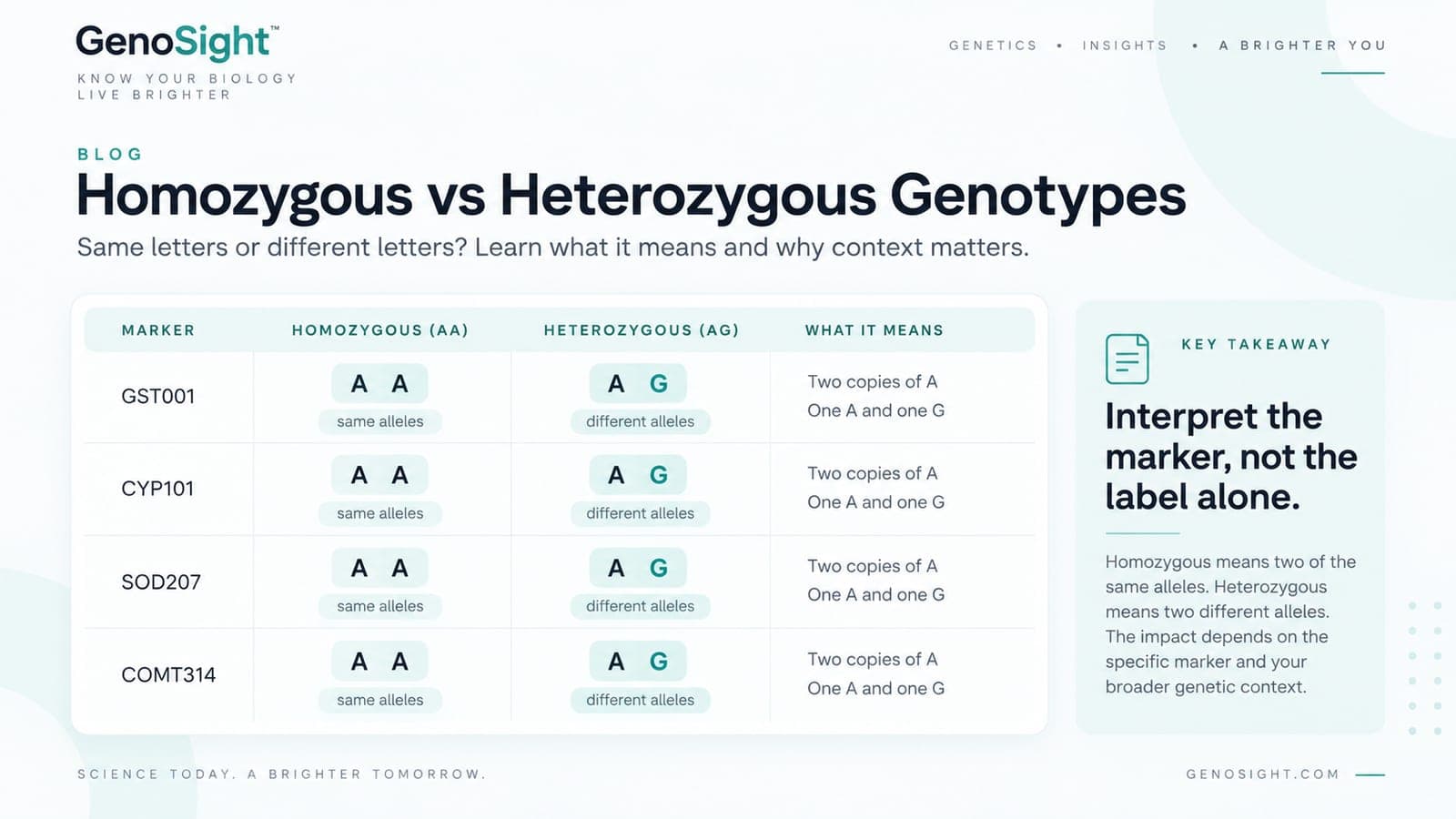
This is why GenoSight articles separate marker identity, genotype, evidence and clinical interpretation. Our genetic variants guide covers that layered workflow in more detail.
Population context and database version matter
The same variant can have different-looking frequencies depending on the dataset, ancestry grouping, genome build and filtering method. The gnomAD production team describes a variant's frequency as the number of allele copies divided by the total number of chromosomes examined, and explains why gnomAD reports frequencies by sex and genetic-ancestry group as well as in aggregate.
Those group labels are not the same thing as race or ethnicity. gnomAD also emphasizes that genetic ancestry is continuous and that discrete groupings are imperfect. For readers, the safe habit is to preserve the source, version and population label rather than copying a single percentage without context.
For example, a frequency statement should be traceable:
| Better note | Weak note |
|---|---|
| "G allele frequency was checked in the named database, version and population group on October 12, 2026." | "This variant is common." |
| "The database counted allele copies, not personal risk." | "This means I am safe." |
| "The result depends on source coverage and representation." | "The frequency applies to everyone." |
The gnomAD population-database review describes reference population databases as essential for variant and gene interpretation, but also as resources with caveats. Treat that caveat as part of the result, not as fine print.
Common is not the same as harmless
Allele frequency is often used in variant classification, but it is not a universal shortcut. The ClinGen variant curation SOP instructs curators to record the frequency, source, allele counts and date when using population-frequency evidence. It also notes that frequency thresholds can be disease-specific and that some high-frequency variants have exceptions.
That is the careful version of a rule people sometimes oversimplify online. A high population frequency can argue against a variant being the sole cause of a rare Mendelian disorder, especially when the database and disease assumptions fit. But the same frequency cannot tell you whether a variant affects a common trait, contributes a small amount to risk, changes drug response, or is relevant only with another variant.
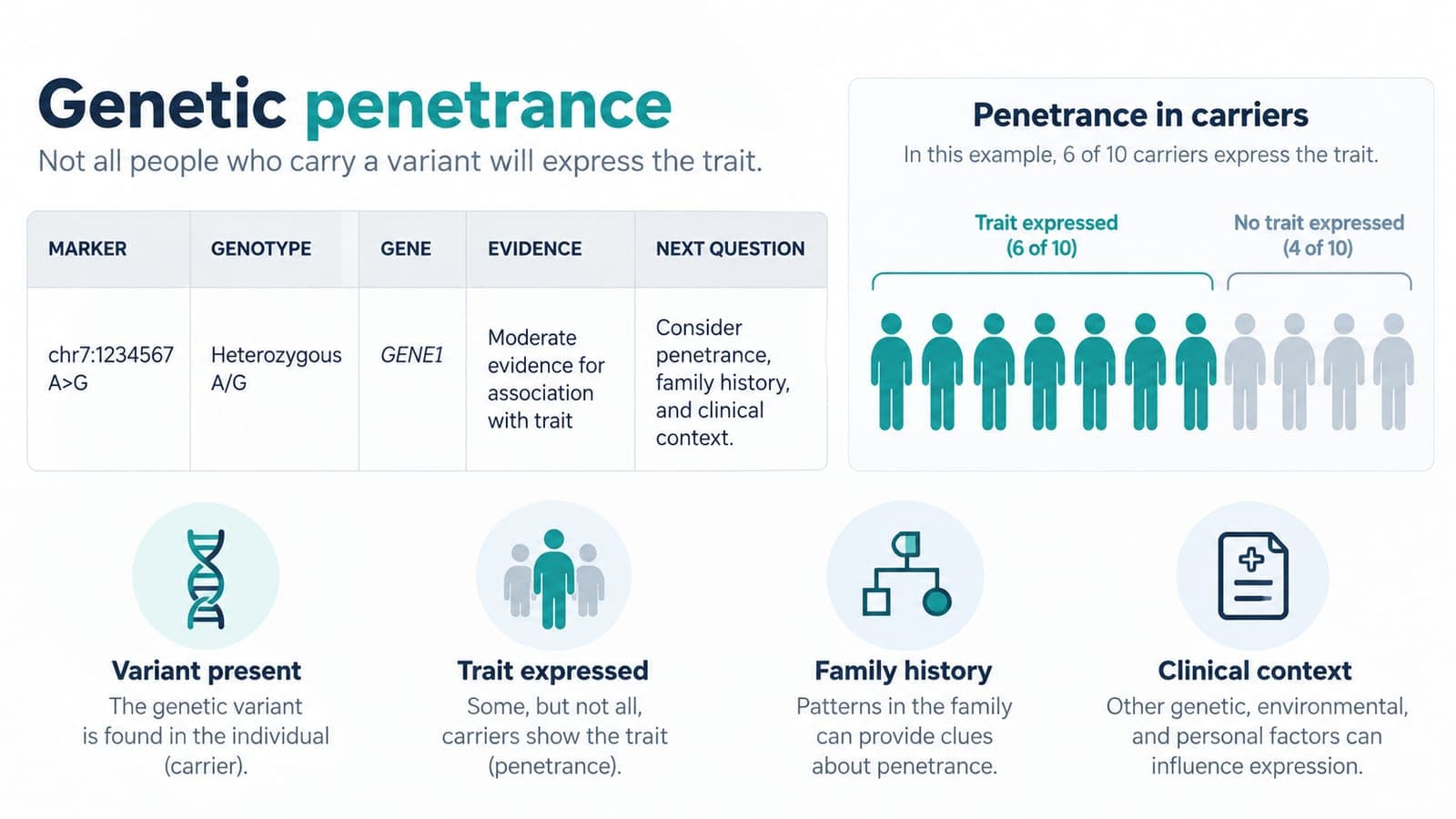
Frequency also does not measure penetrance. Our genetic penetrance guide explains why a variant can be associated with a condition without guaranteeing that every carrier shows the trait. Frequency and penetrance answer different questions.
A safer workflow for checking frequency
Before acting on an allele-frequency number from a raw DNA search, preserve the evidence trail:
- Save the raw row. Keep provider, file date, marker ID, chromosome, position, reference build and genotype together.
- Confirm the marker match. Check whether the database result is using the same rsID, genomic position, build and allele representation.
- Record the frequency source. Note the database name, version, population label, allele count, allele number and access date when available.
- Separate global and group frequency. Do not assume a global average applies equally across all populations.
- Name the claim. Is the source defining a variant, classifying pathogenicity, reporting an association, or recommending clinical action?
- Use clinical follow-up for medical decisions. Do not change screening, medication, supplements or pregnancy care from a raw-file lookup alone.
The MedlinePlus SNP overview notes that most SNPs have no effect on health or development, while some are important for studying health, drug response and disease risk. That mix is exactly why frequency should be read with the evidence source and claim type, not in isolation.
Review raw DNA findings with context
GenoSight turns compatible raw DNA files into educational reports that keep genotype calls, population context, citations and limitations separate.
The practical takeaway
Allele frequency tells you how common an allele is in a defined population dataset. It can help you avoid overreading a raw DNA marker, but it cannot turn a genotype row into a diagnosis or a personal risk estimate. The strongest interpretation keeps the original raw row, the population database, the evidence claim and the medical decision separate.
If a frequency number could affect health care, bring the exact marker, genotype, source and claim to a qualified clinician or genetic counselor. A screenshot of a percentage is not enough context for a medical decision.
Sources
- NCBI Bookshelf - Glossary: allele frequency, accessed October 12, 2026.
- gnomAD - Genetic Ancestry, accessed October 12, 2026.
- Karczewski and Francioli - Variant interpretation using population databases: lessons from gnomAD, accessed October 12, 2026.
- ClinGen - Variant Curation Standard Operating Procedure, accessed October 12, 2026.
- MedlinePlus Genetics - What are single nucleotide polymorphisms?, accessed October 12, 2026.