snps explained
Genetic Health Optimization: DNA-Informed Lifestyle
Generic optimization advice ignores your genetics. Here is how to use your raw DNA file to inform sleep, diet, training, and supplements — with the caveats that matter.
Sebastian · May 1, 2026 · 6 min read
In short
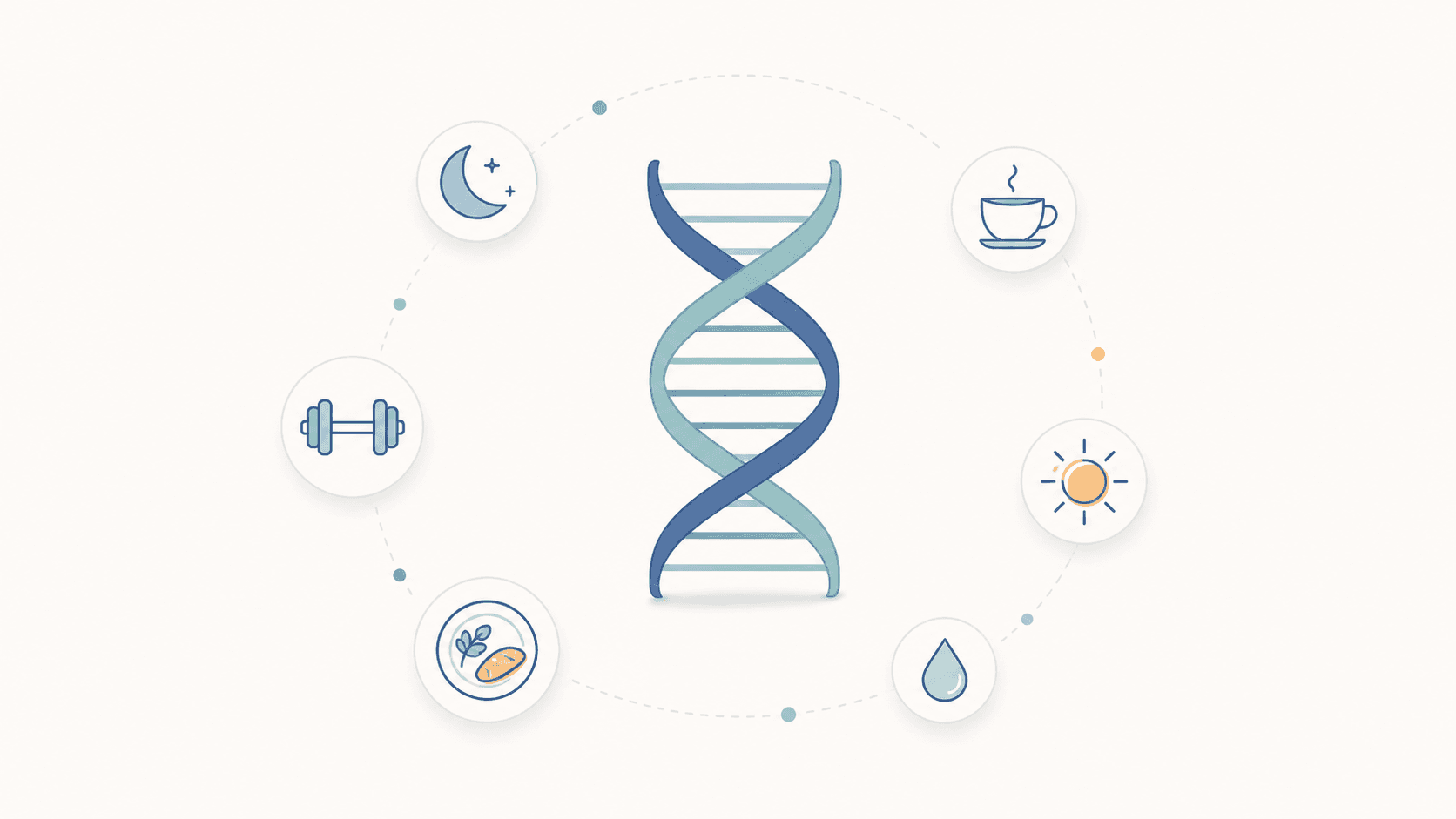
Generic optimization advice (eat more protein, sleep eight hours, train zone 2) is fine as a baseline, but it ignores the half of the equation that's actually personal: your genetics. Lifestyle SNPs in genes like CYP1A2 (caffeine), CLOCK and PER3 (sleep timing), VDR (vitamin D), ADRB2 (exercise response), and methylation genes change how those generic recommendations apply to you specifically. This guide covers the categories where genetic data actually moves the dial, the trap of optimization without context, and how to use your raw DNA file as one input among several.
The premise — and the limit of the premise
Lifestyle SNPs are common variants in genes whose function affects how your body handles common inputs: caffeine, sodium, sleep timing, exercise volume, vitamin and mineral metabolism. Unlike disease variants, they don't predict illness — they describe variation in normal physiology.
The premise is that knowing your variants lets you tailor lifestyle choices instead of guessing. The limit is that variants are one input among several, and lifestyle interventions have to be evaluated against actual outcomes (energy, sleep quality, lab values), not just against the recommendation a variant produces.
A useful frame: variants are hypotheses. Outcomes are evidence. (How that synthesis runs against your full health profile.)
Categories where genetic data actually changes the recommendation
Not every SNP is actionable. The categories below are the ones where the evidence is strong enough that a variant call meaningfully changes the recommendation.
Sleep and circadian rhythm
Variants in CLOCK, PER3, and CRY1 affect chronotype — whether you're naturally wired for early-morning or late-night peak alertness. ADA affects deep-sleep architecture; ADORA2A affects how caffeine disrupts your sleep specifically.
How it changes recommendations:
- A late-chronotype variant doesn't mean you can't be productive at 6am. It means the cost of forcing yourself to is higher than for an early-chronotype person, and that timing your workouts and high-cognitive work to align with your chronotype produces measurably better outcomes.
- An ADORA2A slow variant explains why you can't drink coffee after 2pm without sleep disruption — even if you "don't feel" caffeinated.
Caffeine metabolism
CYP1A2 is the big one. Fast metabolizers clear caffeine quickly and tolerate higher doses without sleep disruption or cardiovascular effects. Slow metabolizers don't.
How it changes recommendations:
- Slow metabolizers benefit from cutting off caffeine earlier in the day or capping daily intake.
- Fast metabolizers can use caffeine more aggressively as a performance tool without the typical downsides.
- The relevant lifestyle question isn't "how much caffeine" but "how much caffeine for me."
Sodium sensitivity
ADD1, AGTR1, and ACE variants affect how blood pressure responds to dietary sodium. Some people see meaningful BP changes with modest sodium reductions; others don't respond much at all.
How it changes recommendations:
- Sodium-sensitive variants warrant tighter sodium tracking and benefit most from DASH-style diet patterns.
- Non-sensitive variants don't get a free pass on sodium — there are still cardiovascular reasons to keep intake moderate — but the urgency around aggressive restriction is lower.
Vitamin D metabolism
VDR, CYP2R1, and GC are widely studied in the literature for their role in how the body converts and uses vitamin D. Variants don't change whether vitamin D status is worth discussing with a clinician; they're one piece of context the literature describes.
How the framing shifts:
- People with reduced-conversion variants are often discussed in the literature as needing more dietary intake or sun exposure to reach a similar blood level. Specific supplementation choices belong with a healthcare provider.
- Vitamin D testing and target ranges are clinical decisions — variants describe a hypothesis about why a level might be where it is, not what to do about it.
Methylation
MTHFR, MTR, MTRR, COMT, CBS affect the one-carbon cycle that handles folate and B12 metabolism, neurotransmitter breakdown, and methylation reactions across the body.
How the framing shifts:
- MTHFR C677T (especially homozygous) is widely discussed in the literature alongside methylated folate (5-MTHF) versus synthetic folic acid. Specific supplementation decisions belong with a healthcare provider.
- Slow COMT variants are described in the literature as more sensitive to methyl-donor supplementation. If a B-complex doesn't agree with you, that's worth raising with a clinician.
- Lab work and supplementation decisions are clinical workflows, not consumer-genomics outputs. We surface the genotype; what to do about it is a clinical question.
Exercise response
ACTN3 affects fast-twitch versus slow-twitch fiber distribution; ACE affects endurance versus power phenotype tendencies. The effects are real but smaller than fitness culture sometimes suggests.
How it changes recommendations:
- Variants are useful for understanding why certain training styles feel easier or harder for you. They're not useful for telling you what sport to pursue.
- Adaptation matters more than predisposition for most non-elite training goals.
Iron handling
HFE variants (C282Y, H63D) are common in European-ancestry populations and are widely described in the literature. Discuss any HFE-related questions with your healthcare provider — Genosight findings are educational only.
How the framing shifts:
- The HFE genotype is one piece of context that a clinician may weigh alongside ferritin, transferrin saturation, and clinical history. None of those decisions belong with a consumer-genomics tool.
- If your report flags an HFE variant, the practical next step is raising it with a healthcare provider rather than self-managing iron intake.
The trap: optimization without context
Genetic data is most useful when interpreted against your full picture. Two people with identical CYP1A2 slow-metabolizer variants might warrant opposite recommendations if one drinks no caffeine and sleeps well, and the other drinks four cups daily and complains of insomnia.
A few common failure modes:
- Variant-only stacking. Adding supplements based on variants alone, without a clinician's input on whether the underlying pathway is relevant for you. The methylated B-complex example is widely cited in the literature, but whether it matters for any specific person is a clinical question.
- Ignoring interactions. A supplement suggestion that interacts with something you're already taking is worse than no suggestion. The current-stack domain is high-leverage for that reason; raising any change with a clinician or pharmacist is the right next step.
- Chasing optimization without measurement. "I added X because my variant suggested it" without any clinical input is faith-based optimization. The discipline is: variant → hypothesis → clinical conversation → measured outcome.
Variants are inputs. Decisions belong with a clinician.
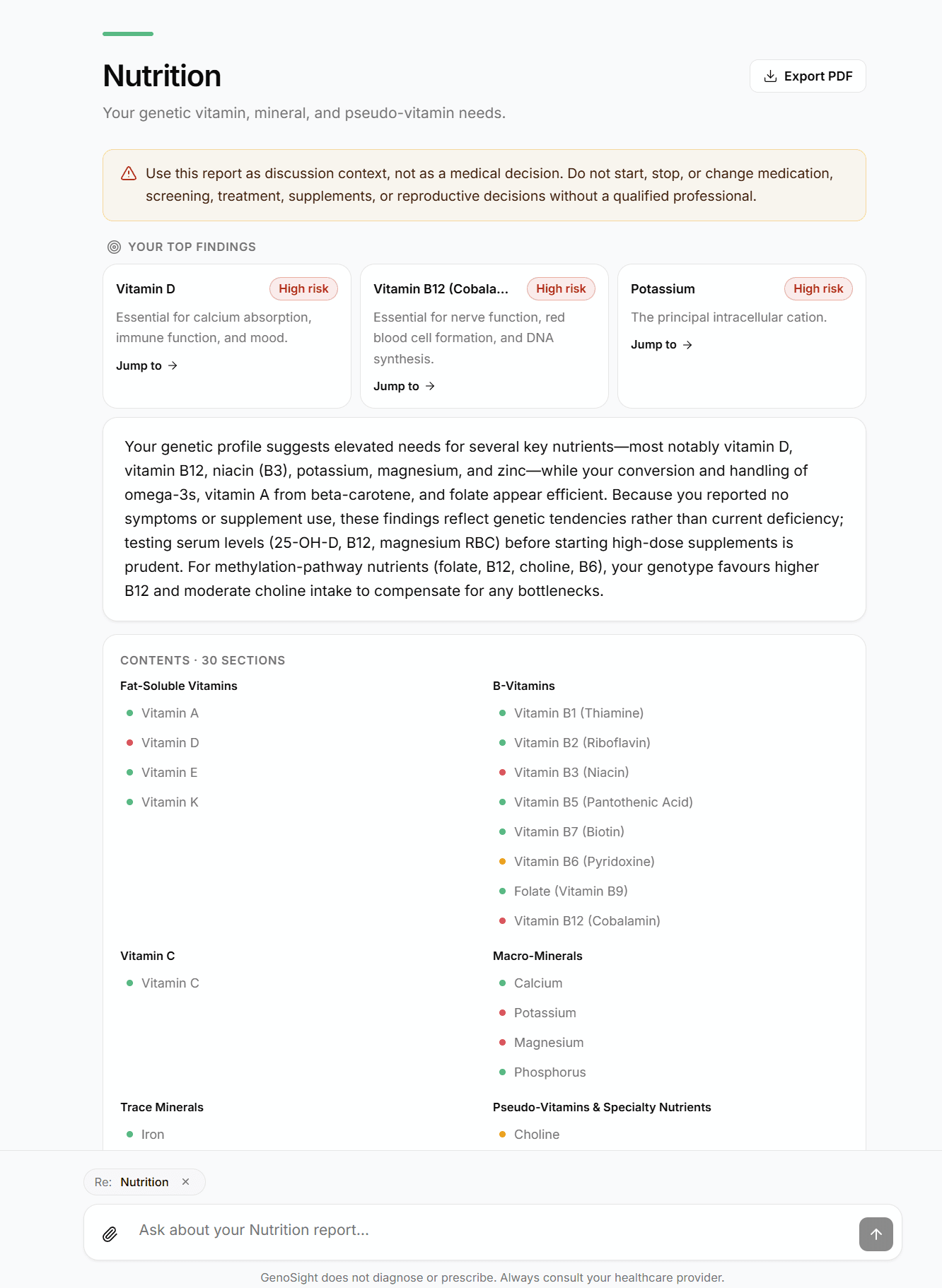
How GenoSight handles lifestyle SNPs
GenoSight's lifestyle SNP engine runs your raw file against a curated catalog of 79 variants across 16 categories. The synthesis step folds your personal-profile context (current supplement stack, habits, goals) into the framing — so a CYP1A2 slow variant produces different educational notes for a heavy coffee drinker with sleep complaints than for someone who drinks decaf. (For the full structure of what's captured, see what's in a GenoSight report.)
The report is educational only. Specific clinical decisions — whether to test, what to take, when to retest — belong with a healthcare provider.
Get personalized lifestyle guidance
GenoSight runs your raw file against 79 lifestyle SNPs and folds findings against your habits and goals. Free trial.
Medical disclaimer
GenoSight provides educational information about your genetic data. It is not a medical diagnosis, treatment, or cure. Always consult your healthcare provider before making decisions based on this information. Variant interpretation evolves; recheck periodically.
Key takeaways
- Lifestyle SNPs describe variation in normal physiology — they tailor generic recommendations rather than predicting illness.
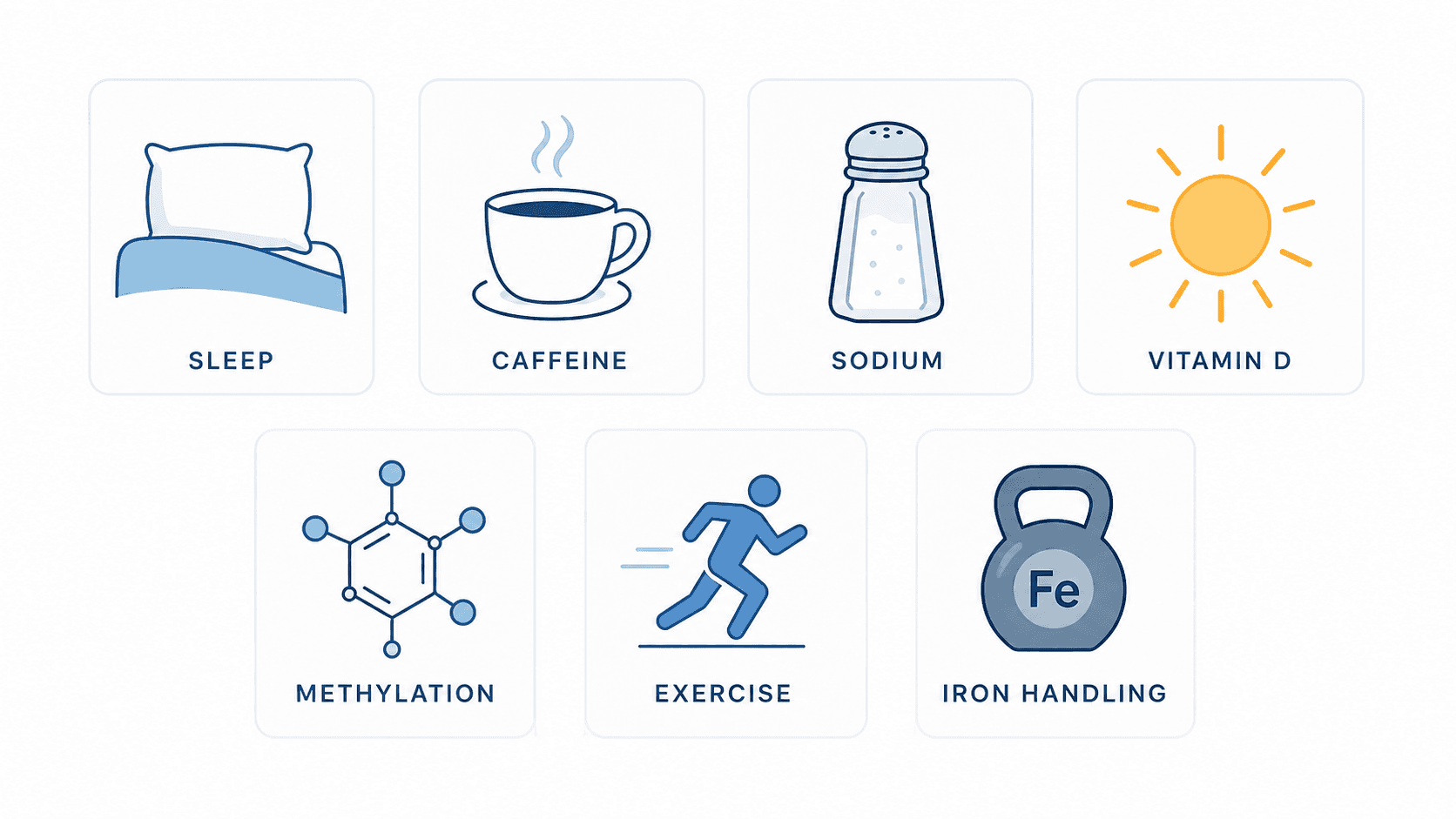
- The categories with the strongest actionable evidence: sleep and circadian rhythm, caffeine metabolism, sodium sensitivity, vitamin D metabolism, methylation, exercise response, iron handling.
- Variants are hypotheses; clinical decisions belong with a healthcare provider. The discipline is variant → hypothesis → clinical conversation → measured outcome.
- Optimization without context fails — current stack, habits, and goals all change how a variant should be framed in an educational report.
- GenoSight's lifestyle SNP engine covers 79 variants across 16 categories and folds findings against your six-domain personal profile rather than producing generic recommendations.
Sources
- Cornelis MC et al. JAMA (2006) — Coffee, CYP1A2 genotype, and risk of myocardial infarction — https://pubmed.ncbi.nlm.nih.gov/16522833/
- Frosst P et al. Nat Genet (1995) — Original characterization of MTHFR C677T — https://www.nature.com/articles/ng0595-111
- NIH Office of Dietary Supplements — Vitamin D Health Professional Fact Sheet — https://ods.od.nih.gov/factsheets/VitaminD-HealthProfessional/
- NCBI GeneReviews — HFE Hereditary Hemochromatosis — https://www.ncbi.nlm.nih.gov/books/NBK1440/